
Celebrating 10 years with APCDA and looking toward the future
 By Poh Li Lau, PhD
On this October 1st, with utmost excitement and gratitude, I will assume my role as APCDA’s President. The timing of me accepting the role as President could not have come at a more fitting time, as it is my 10th year anniversary being a part of the APCDA community! In the blink of an eye the years have passed by. There were so many beautiful memories with the wonderful officers, co-chairs, leaders and members from all over the globe. The support I have received from the APCDA family has brought me here today. The experience working with the team on our 2026 APCDA Hybrid Conference in my home country has definitely been a great opportunity in learning about what leadership is truly about.
During my time as President-Elect, I had the opportunity to really think through what I would like to achieve as my time as President. I have narrowed down three main goals that I want to work on to bring APCDA to a more nuanced place in the Asia-Pacific region. Firstly, I aim to strengthen membership and promotion of APCDA in the Asia and Asia-Pacific region, particularly in countries such as Japan, South Korea and Indonesia. Secondly, I aspire to move the Asia Pacific Career Development Journal (APCDJ) forward by emphasizing getting the journal indexed and creating a legacy for APCDJ. Last but not least, I will focus on ensuring the scholarship program becomes more engaging (e.g., through presentations and internships) and reaches individuals who will greatly benefit from it. I look forward to working on these goals with the support of our APCDA officers and leaders.
 By Natalie Kauffman
Our APCDA Committee Council wanted to express our sincere appreciation to all our members and friends who recently completed the association’s Annual Survey. This Survey provided multiple new members across APCDA’s nine (9) committees, https://asiapacificcda.org/committees/, and a couple of Co-Chairs, too. We also wanted to send a SHOUT OUT to our one hundred twenty-five (125) 2026 Scholars.
Please meet some of our new committee members and find out more about our nine (9) committees . . .
Co-Chairs Dr. Narendar Chadha (& former APCDA President), Mr. Tuấn Anh Le (& Website Administrator), and Dr. Ma. Leonila “Nila” Urrea (& Treasurer), warmly welcome Dr. Barbara Hilton Suddarth, U.S.-TN, as a new Co-Chair to the Awards & Scholarships Committee.
Our sincere appreciation goes out to Dr. Chadha for his past committee leadership. We are currently looking to fill the Co-Chair for our Scholarships side of this committee. Please send your leadership interest to Committee Council Chair, (Bylaws@AsiaPacificCDA.org).
Please note the 2027 Submission Deadline for Awards is February 15, 2027 and for Scholarships is January 15, 2027.
- Mr. Allan Gatenby (also Accreditation Coordinator & immediate past APCDA President) and Mrs. Natalie Kauffman, (Committee Council Chair & Membership Committee Co-Chair), both Co-Chairs of the Bylaws & Policies Committee, also are delighted to share that they are currently working on revising the association’s POLICIES AND PROCEDURES MANUAL. Please contact them if you are interested in joining their efforts, (Bylaws@AsiaPacificCDA.org).
- Dr. Vandana Gambhir Chopra, Chair of the Ethics & Standards Committee is proud to share their newly developed Career Center Checklist for higher education settings. Available now in our website’s RESOURCES section, https://asiapacificcda.org/career-center-checklist. The committee is beginning Case Study Research with institutions using the Checklist. Please contact the Chair, Ethics@AsiaPacificCDA.org, if your institution is currently using the Checklist and would like to participate in the research.
Membership Committee Co-Chairs, Mr. Kunimitsu Kuki, and Mrs. Natalie Kauffman (also Committee Council Chair & Bylaws & Policies Committee Co-Chair), already have onboarded all four (4) of their new committee members: Dr. Lucila Bance, Philippines (also APCD Journal Editor and member of both the Awards & Scholarships and Ethics & Standards Committees); and Rosette Morga, Philippines; Dr. Elynor Sayson, Philippines; and Bory You (also Cambodia Area Representative and PR Committee member). All four have been introduced to the committee’s process of providing individual, engagement conversations and regularly scheduled Orientation & Meetup webinars.
BOLO (Be On the Look Out) for the Membership Committee’s 4th Community of Practice gathering scheduled for Tuesday evening/Wednesday morning, November 17/18. The topic and registration link for this event will soon be available.

By Dr. Elisabeth Montgomery
At the August Members’ Forum, colleagues from across the region shared how our Collaborative Portrait resonates in their countries. Their active participation in discussing and refining it highlights their valuable role in shaping our shared vision.
In May, fourteen officers, board members, and staff held the annual APCDA Retreat in Kuala Lumpur to make a long-term plan for the organization. From the meeting emerged a hand-drawn portrait of who APCDA is becoming: a metaphor of climbing a mountain together, the statement Connect, Reflect, Inform, Grow a Global Community, and our DNA values. Members accepted the Portrait!.
- At the June 20 Annual Membership meeting, we brought it to you to review and reflect on for feedback. Leadership then met again to organize the values into five main categories.
- On August 20/21, we held a member webinar to review the Portrait and DNA one more time to make sure we covered a wide range of member perspectives.
Pooja Khanna read her interpretation of the drawing back to us better than we had drawn it. “The mist,” she said, “is the uncertainty we are navigating in a disrupted world. The upward climb is new technology and continuous learning. The holding of hands is facing it together.”
What came next was even more valuable.
Universal values, and local practice. Over and over, members took a shared value and showed us what it requires on the ground in their own country. Tsurayya Syarif Zain explained that in the Indonesian context, leadership means direction, accountability, and the effective implementation of programs and policies. Remy Rose Poblete told us that stronger ties with policymakers are what sustain career development initiatives in the Philippines.
From Guangzhou, ZhengXin made the session’s sharpest observation: many people understand what transformation is, but far fewer know how to transform. What we need, he said, is the action of transformation. Lina Kaing asked whether our value of Sense of Family might be defined, in practice, as respect and empathy.
 By Matthew Sin
We are proud to announce the release of the APCDA Simplified Chinese Glossary, a landmark resource designed to bridge the gap between global career development standards and the diverse professional landscape of Greater China.
Developed by a dedicated task force of regional representatives and career development leaders from Mainland China, Hong Kong, and Macau, this glossary features 208 essential terms. Our approach prioritizes clarity and context, utilizing a rigorous three-layer methodology:
Layer 1 (Original English): Preserves APCDA’s foundational terminology for cross-cultural academic and professional reference.
Layer 2 (Chinese Context): Adapts terms to match local professional expressions in career counseling, education, and talent development.
Layer 3 (Localized Definitions): Rewrites and expands definitions to align with local professional practices while maintaining transparency through clear explanatory notes.
Organized by nine major themes rather than simple alphabetical order, this glossary is designed for intuitive navigation. It serves as a vital tool for practitioners, educators, and institutions in the region to engage more deeply with the APCDA community. We hope this resource fosters stronger connections and supports the growth of career development services across Greater China.

Most of us can remember someone who made room for us.
A teacher who saw potential. A mentor who shared their time. A senior colleague who introduced us to a professional community. A conference where one conversation changed the way we thought about our work.
As our careers progress, we begin to realise that these moments were not small. Someone chose to open a door, and that opportunity became part of our professional journey.
Today, we have the opportunity to do the same for someone else.
For the 2027 APCDA Hybrid Conference, we hope to provide scholarships to 60 individuals from not-high income areas and conflict-affected regions, enabling them to participate in an international professional community that might otherwise remain beyond their reach.
These are students who could become tomorrow’s career practitioners, educators, researchers, counsellors, and leaders. Their circumstances may differ, but they share something important: the potential to contribute to the future of our profession.
Talent is Everywhere. Opportunity is Not.
A professional conference can mean something very different when you are at the beginning of your journey.
It is not simply about attending sessions. It can be the first opportunity to hear internationally respected professionals share their ideas. The first chance to discover how career development is practised in another country. The first conversation with someone whose work you have studied. The first professional connection that grows into mentorship, collaboration, or opportunity.
 By Baktiar Hasnan
Executive Summary
Across the Asia-Pacific region, the world of work is changing rapidly. Artificial intelligence is reshaping jobs and recruitment, employers are placing greater emphasis on skills, governments are investing in workforce development, and education systems are responding to new economic realities. At the same time, concerns around youth employment, skills mismatch, career transitions and workforce mobility are creating new challenges. This article offers a window into these trends and the initiatives being developed across 14 areas/region to prepare people for a changing labour market.
Economic and Labour-Market Trends
The regional picture is mixed. Australia’s unemployment remained at 4.4%, despite employment growth, while Hong Kong recorded 4.3% year-on-year GDP growth in Q2, with unemployment at 3.7% but greater pressure on younger workers. Kazakhstan reported positive economic activity alongside 10.3% inflation, highlighting how purchasing power increasingly affects career decisions. Canada saw improving employment but continuing youth-employment concerns, while the United States reported cautious hiring and growing AI-related pressure on entry-level roles. Macau, meanwhile, is linking talent attraction directly to economic diversification.
AI, Skills and the Future Workforce
AI has become a defining regional theme. Singapore combines high AI adoption with human judgement and governance, while Japan sees automation as an opportunity for career counsellors to concentrate on deeper human interventions. Vietnam’s ambitions are particularly significant: by 2030, it aims to develop 100,000 digital technology enterprises and train more than three million digital workers. Malaysia similarly reports growing emphasis on AI literacy, digital capability and interdisciplinary skills.
 By Arun Mittal
One of APCDA’s greatest strengths is the diversity of voices and experiences that come together at our Annual Hybrid Conference. To ensure that this diversity continues to grow, we are launching our fundraising initiative to support scholarships for the 2027 APCDA Annual Hybrid Conference in Singapore.
Our goal is to provide 50 scholarships, each valued at more than USD $240, to help make conference participation possible for those who might otherwise be unable to attend. These scholarships support students, student presenters, career development professionals from conflict-affected regions, and leaders from not high-income countries.
For many recipients, a scholarship is more than financial assistance. It is an opportunity to learn from global experts, share local perspectives, build meaningful professional relationships, and bring new ideas back to their communities. Last year, scholarship recipients represented 21 countries, and for many, the APCDA Annual Hybrid Conference was their first opportunity to participate in an international professional conference. Many past scholarship recipients have remained actively involved with APCDA as members, volunteers, presenters, and leaders, extending the impact of each scholarship well beyond the conference itself.
 By Dr. Vandana Chopra Ghambir
What if you could review your entire career center, identify strengths and gaps, prioritize improvements, strengthen partnerships, and create a clear roadmap for growth—all with one practical tool?
The APCDA Career Center Checklist is a comprehensive resource designed to help institutions build, strengthen, and continuously improve career centers across diverse contexts and settings.
✨ How and When to Put This Checklist to Work?
- When building a new career center and looking for a roadmap to get started.
- When reviewing existing services and asking, “What should we improve next?”
- When developing strategic plans, annual goals, or future priorities.
- When preparing for accreditation, rankings, quality assurance, or institutional reviews.
- When seeking funding, resources, leadership support, or external partnerships.
- When bringing stakeholders together to create a shared vision for student success.
- Whenever your institution is ready to innovate, evolve, and take career development to the next level.

APCDA members have spoken, and we are delighted to introduce Mrs. Effrosyni (Sini) Parampota as APCDA’s President-Elect.
Over the next three years, Sini will serve in APCDA’s leadership succession as President-Elect (2026–27), President (2027–28), and Past President (2028–29), helping guide the association through its next chapter. We are excited about the experience, dedication, and thoughtful leadership Sini will bring to this important role as APCDA continues to strengthen the career development profession across the Asia-Pacific region.
This election reflects the strength of APCDA as a member-led association. We are deeply grateful to every candidate who stepped forward to serve. Standing for election is a significant commitment, and every nominee demonstrated a willingness to contribute their time, expertise, and vision for the future of our profession. While there can only be one successful candidate, every person who accepted the nomination has helped strengthen our association.
 By Arun Mittal
APCDA has initiated an accreditation process for training programs designed for career development practitioners and offer a credential upon completion of the training program. We call these programs Career Development Credentialing Programs, so we call our process CDCP Accreditation. CDCP Accreditation has been designed to strengthen and recognize quality career development training across the Asia-Pacific region.
As career development continues to emerge as a critical profession in supporting individuals through education, employment, and lifelong career transitions, there is a growing need for training programs that meet recognized standards of quality and professional practice. APCDA’s CDCP Accreditation has been developed to address this need by providing an independent review and endorsement of career development training programs.
The purpose of accreditation is not to replace or compete with existing training programs. Rather, APCDA Accreditation serves as an added layer of professional recognition, enhancing the value and credibility of both established and newly developed programs. Training providers can continue to deliver their unique curriculum, methodologies, and learning experiences while benefiting from APCDA’s endorsement that their programs align with recognized career development competencies and professional standards.
Under this initiative, universities, professional associations, private training providers, government agencies, and educational institutions offering career development education may apply to have their programs reviewed. Accredited programs will demonstrate that they adequately prepare learners with the knowledge, skills, ethical understanding, and professional competencies expected of career development practitioners.
 By Grace Koamesah
The 2026 APCDA Hybrid Conference in Kuala Lumpur, Malaysia, has been another unforgettable experience. Beyond the applause, a conference’s success is reflected not only in its sessions but also in the insights of its attendees. Following the event, attendees were invited to share their overall feedback through a post-conference survey in Whova. This summary presents the highlights of the survey results from 41 respondents who shared their insights on what they value most from the conference, as well as valuable improvements for future conferences.
Valuable aspects of the conference
Respondents were asked to rank the aspects of the conference that influenced their decision to attend (6 = Most important, 1 = Least important), with Presentation quality ranked as the most important aspect (4.20). This finding is supported by the open-ended responses where 46% of respondents commented that they gained valuable insights from presenters of diverse backgrounds and from the wide range of topics. The second highest-ranked aspect is Networking (3.82), and 60% of respondents appreciating the opportunity to connect with fellow career advocates and industry professionals across the Asia-Pacific region. The third most important factor was Overall cost (3.45). Many respondents highlighted APCDA’s sense of purpose and strong sense of belonging and camaraderie, noting that interactions with career practitioners from different countries reinforced the value of APCDA membership.
by Elisabeth Montgomery, PhD
The APCDA 2026 Conference welcomed scholars from across the Asia Pacific and beyond as one shared professional community. Through conference sessions, informal exchanges, and guided conversations, scholars connected across regions, disciplines, and telling their lived experiences. Those attending the Conference in person brought their voices and inquiries forward, engaging leaders in fresh perspectives on career development, inclusion, resilience, and the future of work.
Within this wider scholar community, APCDA also welcomed Resilience Scholars whose professional commitment continues under conditions of conflict and disruption. Their presence deepened the meaning of inclusion—not as a separate category, but as a shared responsibility to create access, dignity, and belonging for all scholars.
By Dr. Elisabeth Montgomery
In Kuala Lumpur on May 1, the full APCDA board, officers, and staff gathered to create a shared purpose, inspiring a sense of unity and collective pride in shaping our future. What emerged was more than a strategic plan. It was an articulation of APCDA’s DNA, our values, commitments, and aspirations that bind this Asia Pacific community together. We also articulated a calling: to connect, reflect, inform, and grow a global community of practice in career development.
There was something different about those of us in the room by the time the closing remarks began. Participants described it as a palpable shift in atmosphere that led to a deepened sense of trust and common purpose, transforming a routine governance gathering into something more like a founding moment by the end of a six-hour day at the Urban Living Residence in Kuala Lumpur. The APCDA 2026 Leadership Retreat set the course for everything the association intends to become.
The retreat brought together the full board, officers, and staff, with several participants connecting virtually and across time zones to address three interlocking questions: What do we truly stand for? How do we build structures that last? And who will carry APCDA’s mission forward into a rapidly changing career development ecosystem?
The image below is the answer the room produced together. It is the Collective Portrait of APCDA’s shared identity and the hub to which everything else in this article connects.
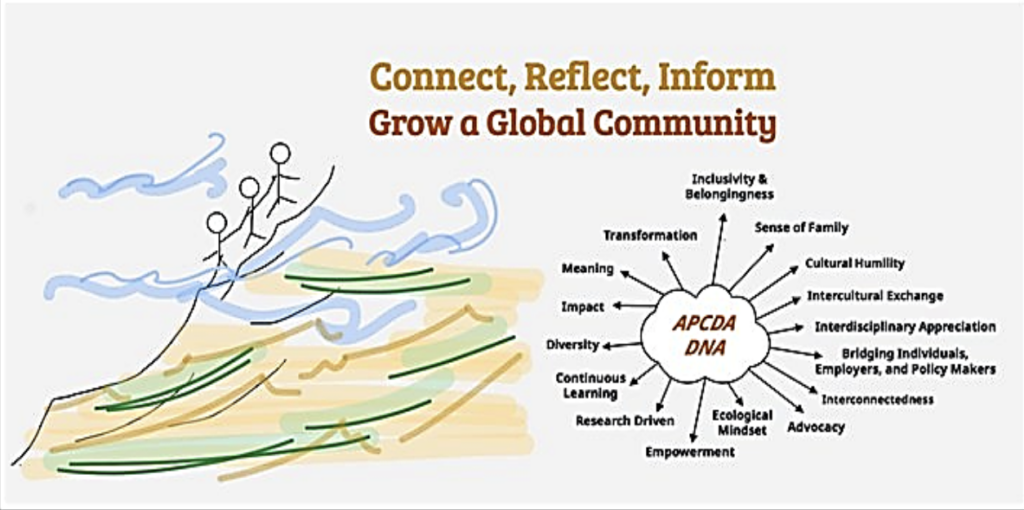
The APCDA Collective Portrait. At its heart, APCDA’s DNA and the values that define who we are is the path we walk together.
What APCDA’s DNA contains
The values radiating from the center of the Collective Portrait were named, refined, and arranged by the participants themselves as the retreat unfolded. From the emerging individual reflections, tested in collective conversation, we finally drew the vision together into a single picture. Three main categories of commitment come into focus:
How we belong to each other: Inclusivity & Belongingness, Sense of Family, Cultural Humility, Intercultural Exchange, Interconnectedness, and Diversity.
How we work in the world: Bridging Individuals, Employers, and Policy Makers; Advocacy; Interdisciplinary Appreciation; Research Driven; Ecological Mindset; Empowerment.
How we grow: Continuous Learning, Meaning, Impact, and Transformation.
The top of the Portrait features four words serving both as a vision and an invitation:
Connect. Reflect. Inform. Grow – A Global Community. In other words, expand our Global Community. These words are an open call to all members, emphasizing that our collective growth depends on active community engagement and shared effort.
Why a retreat and the emerging vision?
Years of growth in membership, conferences, and regional reach revealed structural gaps that routine board meetings could not address. We needed quality time together to develop clearer roles for leaders and staff, conference protocols stretched by complexity, a revenue model facing the limits of scalability, and the unanswered question of who would carry APCDA forward.
Sini Parampota and Allan Gatenby selected Role Biography (Long, 2026) as their leadership development method. We had practiced this last year with significant success. This socio-analytic approach encourages participants to examine their professional journeys by considering both the roles they have undertaken and those they aspire to pursue. This methodology surfaces the patterns, values, and motivations that conventional strategic planning rarely reaches. Members create safe space conditions for alignment and trust, making the visions of the DNA Portrait viable.
The people who made it happen. Lead facilitators Allan Gatenby (Past President) and Sini Parampota (Secretary) joined remotely. In the room: Elisabeth Montgomery (President & Co-Facilitator), Lau Poh Li (President-Elect & Host), Nila Vitug-Urrea (Treasurer), Roberta Borgen (Board/Committee), Natalie Kaufmann (Board/Committee), Brian Schwartz (Officer/Area Council), Baktiar Hasnan (Chair, Area Council). Staff team: Arun Mittal (Executive Director), Marilyn Maze (Finance), Emily Lizada, Tuan Anh Le, and Grace Koamesah (Association Assistants). Gaini Yessembekova (PR Committee) could not attend.
Three main themes ran through every stage: Leadership development, mapping directly onto the DNA values of Continuous Learning, Empowerment, Transformation, and Impact.
 By Natalie Kauffman
APCDA’s nine (9) currently active committee volunteer staff along with journal volunteer staff total almost 130 association members and span the following 25 countries and 2 SARs: Australia, Cambodia, Canada, China, Egypt, Hong Kong, India, Indonesia, Japan, Kazakhstan, Kenya, KSA, Lebanon, Macau, Malaysia, Mongolia, New Zealand, Pakistan, Philippines, Samoa, Singapore, S. Korea, Taiwan, United States, Vietnam, and Yemen
Awards & Scholarships Committee Awards Co-Chair (& former APCDA President), Prof. Dr. Narender K Chadha, shared the deadline for our 2025 APCDA Awards is fast approaching, Sunday, March 15th. The three (3) possible awards include: Outstanding Career Practitioner Award, Outstanding Educator of Career Professionals Award, and Lifetime Achievement Award. For further details on our association’s 2026 Awards Nomination Process, pease see: https://asiapacificcda.org/awards/
Scholarship Committee Co-Chairs Tuan Anh Le and Dr. Ma. Leonila V. Urrea (& current APCDA Treasurer) determined the selection criteria by which over 140 scholarship applications were evaluated and 123 scholarships were awarded. The Resilience Scholarship team have been virtually meeting with conflict-zone scholarship applicants. The committee will provide a Scholar Meetup in April to prepare scholars to take advantage of the conference and a video of the selected scholarship recipients which will be shown during the Awards Ceremony at our upcoming Malaysia conference.
Bylaws Committee Co-Chairs Allan Gatenby (also immediate past APCDA President, Accreditation Committee Chair, & Nominations & Elections Committee Chair) and Natalie Kauffman (also Committee Council Chair & Membership Committee Co-Chair) and the Bylaws team have met to discuss possibly adding five (5) additional components to APCDA’s Policy and Procedures (P&P) Manual. They cordially invite all interested association members to join them on Sunday evening, March 22/Monday morning, March 23 to begin to update APCDA’s P&P Manual. Whether you have previous nonprofit bylaws writing/editing experience or are interested in building your experience, your participation is warmly welcomed. If interested in attending, please email the Co-Chairs at Bylaws@AsiaPacificCDA.org.
Ethics and Standards Committee Chair, Dr. Vandana Gambhir Chopra and the committee team are gearing up for their Malaysia Conference presentation; an interactive session inviting career development professionals to collaboratively reflect on existing standards and ethical practices in the field. Participants will have the opportunity to share perspectives, identify emerging ethical challenges, and help strengthen a shared, values-driven professional framework.
News Committee Chair, Momoko Asaka, (& former APCDA President) invites submissions to APCDA’s Weekly News. Please link to the following and scroll down for the HOW To guidelines:
https://asiapacificcda.org/news/
Natalie Kauffman and Kunimitsu Kuki, Membership Committee Co-Chairs, and the Membership Committee have been enjoying meeting with NEW and potential APCDA members through individual and
At APCDA, much of the work is done by our Standing Committees (groups that continue year after year). All members are welcome to join.
Joining a committee is a great way to get to know other members personally and build global relationships, in addition to providing a really valuable contribution to the field of career development. Below are comments from the chairs of our standing committees about the unique benefits each committee offers.
Natalie Kauffman, Membership Committee Co-Chair
 “APCDA offers a lot of services, more than most members know about. Members of the Membership Committee help others learn how to use these services and connects you to the new members and potential new members. You can build worldwide connections and help others to take full advantage of what APCDA has to offer.”
Kunimitsu Kuki, Membership Committee Co-Chair, Membership@AsiaPacificCDA.org
 “Joining the Program Committee offers a unique opportunity to shape impactful professional development for APCDA members by identifying relevant topics, connecting with expert speakers, and facilitating engaging webinars. As a committee member, you’ll contribute to the continuous professional development of career professionals across the Asia-Pacific region, while also expanding your network and enhancing your professional skills.”
Syed Hassan Abdullah, Program Committee Co-Chair, Program@AsiaPacificCDA.org
“We invite you to join the Research Committee, where your experience can play a pivotal role in advancing the field of Career Development and driving impactful change. Collaborate with dedicated professionals to shape innovative research initiatives that enhance career pathways and empower individuals to achieve their goals. Together, we can inspire new ideas and foster a culture of research and innovation!”
Dr. Poh Li Lau, Research Committee Co-Chair, Research@AsiaPacificCDA.org
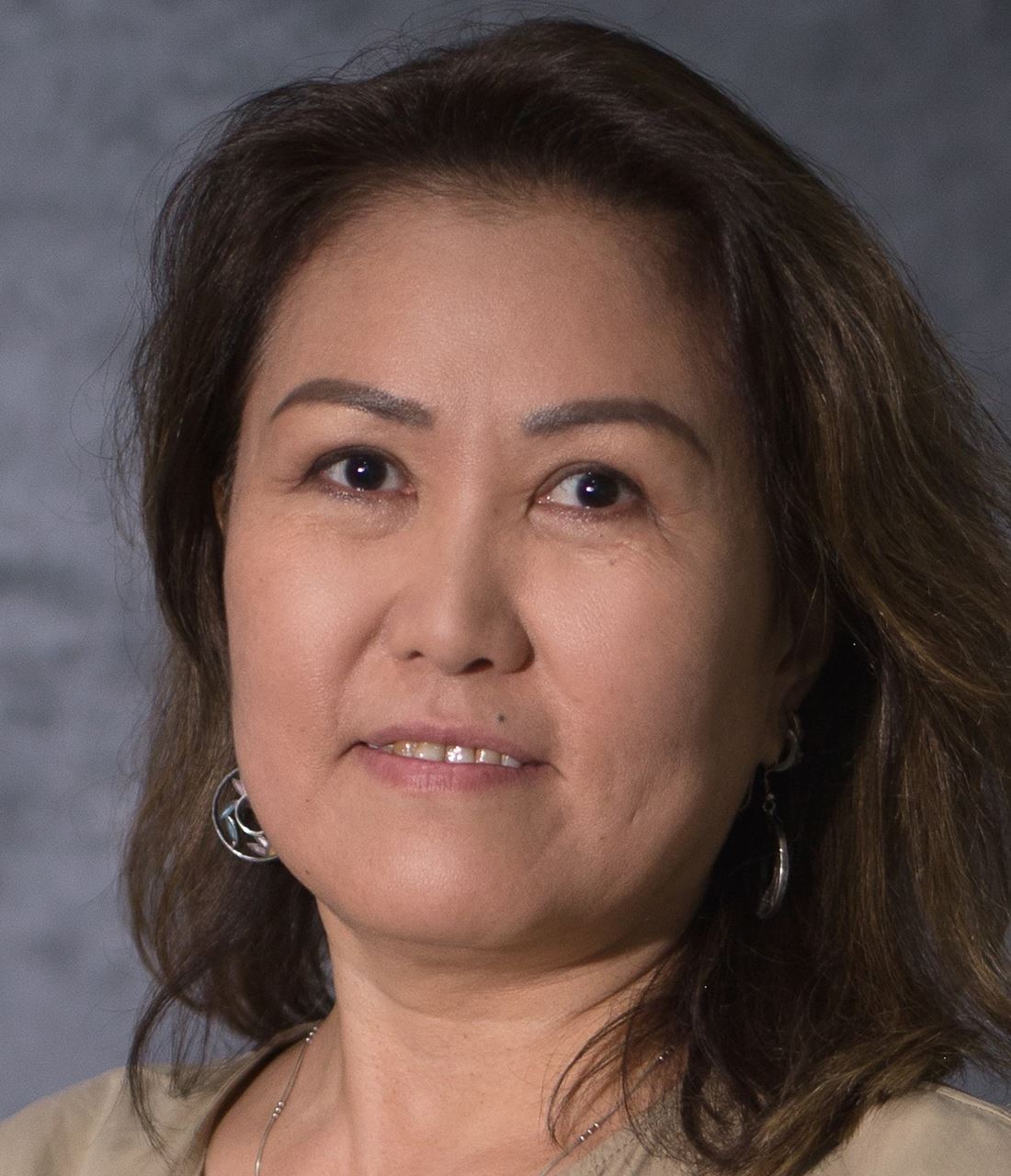 “PR Committee plays a key role in developing strategies to enhance APCDA’s visibility both in our region and globally. Additionally, you will have the chance to enhance your skills in virtual presentations, team-building, and project management—skills that are highly transferable and beneficial across various professional contexts. Most importantly, you will be making a meaningful contribution to raising APCDA’s profile.”
Gaini Yessembekova, Public Relations Co-Chair, PublicRelations@AsiaPacificCDA.org
“PR Committee plays a key role in developing strategies to enhance APCDA’s visibility both in our region and globally. Additionally, you will have the chance to enhance your skills in virtual presentations, team-building, and project management—skills that are highly transferable and beneficial across various professional contexts. Most importantly, you will be making a meaningful contribution to raising APCDA’s profile.”
Gaini Yessembekova, Public Relations Co-Chair, PublicRelations@AsiaPacificCDA.org
 “Our Ethics and Standards Committee is where your voice can truly shape the future! Imagine contributing to the very principles that guide our profession globally—standards that empower trust, integrity, and professional growth. Join us, and let’s set the gold standard together while building a network of passionate professionals dedicated to making an impact.”
Vandana Gambhir, Ethics and Standards Committee Chair, Ethics@AsiaPacificCDA.org
“Our Ethics and Standards Committee is where your voice can truly shape the future! Imagine contributing to the very principles that guide our profession globally—standards that empower trust, integrity, and professional growth. Join us, and let’s set the gold standard together while building a network of passionate professionals dedicated to making an impact.”
Vandana Gambhir, Ethics and Standards Committee Chair, Ethics@AsiaPacificCDA.org 
APCDA is an association of people who love their work and are eager to share their expertise with others. It is our goal to make that sharing as easy as possible.
In November 2023, we moved to a new website and new member database software which offers a “Member Portal” to facilitate communication among members and displays our other member services. Your Member Portal is a vital part of the services offered by APCDA. The new software offers several valuable features that were previously scattered over 2 software systems.
Unfortunately, networking with each other became more difficult when we switched because we were not able to copy the photo and bio of our members to the new system. Have you updated your Member Profile in the Member Portal? If not, we urge to do this now. Another vital piece of information is the Country where you live. Unfortunately, our new software hides that information under Address. Since we do not communicate by mail, “Address” does not seem very important. But your Country is important (and your city). December is a month for giving. We hope all of our members will make it easier for other members in need of your advice and assistance to find you by adding a photo of your face, a bio describing your areas of focus, and your country. Please help us to make member networking easier.
 Did you know that you automatically become a member of the International Association of Educational and Vocation Guidance (IAEVG) when you join APCDA? Each year, APCDA pays dues to IAEVG for all of our members.
IAEVG has a 75-year history of providing global leadership in and advocating for guidance by promoting ethical, socially just, and best practices throughout the world so that career, educational and vocational guidance and counselling is available to all citizens from competent and qualified practitioners.
Behind the scenes, IAEVG and many of its members have helped in the development of APCDA. When we want to develop resources for our members, such as our Ethical Guidelines, we turn first to IAEVG for guidance. As the oldest career development association that is truly international, the materials provided by IAEVG are very relevant and helpful in jump-starting our development.
Members are invited to download a copy of the Member Logo from the APCDA Website. The legal agreement published on our website makes it possible for our members to use this logo on your website, signature, or letterhead. We currently have five kinds of member logos:
- Individual Members
- Organization Members
- Lifetime Members
- Legacy Partner Lifetime
- Professional associations which offer Joint Membership with APCDA (Affiliates)
If you fall into groups 1 to 4, please go to our website at AsiaPacificCDA.org and click “Member Portal.” Choose Workspaces, and your member logos (as JPG or PNG files) should be waiting there for you to download. If you fall into the fifth group, you should have received the logo from us by email.