

Malaysia Representative:
Alicia Ch'ng
Head of Careers Advisory Service
University of Nottingham Malaysia
Malaysia@AsiaPacificCDA.org
Alicia Ch'ng
Head of Careers Advisory Service
University of Nottingham Malaysia
Malaysia@AsiaPacificCDA.org
Executive Summary
As the APCDA Malaysia Representative, I have continued to promote career development, employability, talent development, and professional networking opportunities through active engagement with academic institutions, professional bodies, psychologists, counsellors, educators, and industry practitioners.
Key developments during the reporting period include increased focus on Artificial Intelligence (AI), employability, lifelong learning, mental health, career resilience, and industry-academia collaboration. Malaysia continues to strengthen its human capital ecosystem through collaborative initiatives that support workforce readiness and sustainable career development.
Malaysia Update
Malaysia remains committed to developing a future-ready workforce through initiatives that emphasize:
The career development profession is increasingly recognized as a critical component in supporting workforce transitions, employability, and organizational sustainability.
Professional Engagement and Activities
Persatuan Psikologi Malaysia (PSIMA)
As an active member of Malaysia’s professional psychology and career development ecosystem, I have supported initiatives that bring together practitioners, researchers, educators, and students.
A major highlight is the upcoming:
International Psychology Conference (IPC) 2026
Date: 17-18 August 2026
Venue: HELP University, Subang Bestari Campus, Shah Alam, Selangor
The conference provides opportunities for interdisciplinary discussions on:
Workshops and Professional Development Activities
Several educational workshops are being conducted alongside IPC 2026 to strengthen practitioner competencies.
AI and SEM AMOS for Psychological Data Analysis
Facilitator: Dr. Wan Nurul Izza (UPSI)
Areas covered include:
Reminiscence Therapy for People Living with Dementia
Facilitator: Prof. Dr. Ponnusamy Subramaniam (UKM)
Focus areas include:
These initiatives contribute significantly to continuing professional development among helping professionals in Malaysia.
Emerging Trends in Malaysia
Artificial Intelligence in Career Development
AI is increasingly influencing:
Career practitioners are exploring ways to integrate AI while maintaining ethical and human-centred practice.
Employability and Future Skills
Employers continue to prioritize:
Universities and training providers are responding through curriculum enhancements and micro-credential initiatives.
Mental Health and Career Wellbeing
There is growing awareness regarding:
Mental health considerations are becoming an integral component of career development programs.
APCDA Opportunities in Malaysia
Potential opportunities for APCDA engagement include:
Professional Development
Research Collaboration
Student and Emerging Professional Engagement
Strategic Partnerships
Challenges
Current challenges include:
Priorities for the Remainder of 2026
As APCDA Malaysia Representative, my priorities include:
Conclusion
Malaysia’s career development landscape continues to evolve in response to technological advancement, workforce transformation, and changing societal needs. The integration of career development, psychology, employability, and lifelong learning presents valuable opportunities for APCDA engagement and collaboration.
As APCDA Malaysia Representative, I remain committed to advancing the association’s mission by fostering partnerships, promoting professional development, and supporting the growth of career development practice across Malaysia and the Asia-Pacific region.
Country Overview
Malaysia continues to strengthen its national focus on talent development, employability, and career sustainability, aligned with economic transformation priorities such as digitalisation, TVET reform, and youth employability.
Key national priorities include:
Malaysia’s national direction is strongly supported by the National TVET Policy 2030, which aims to produce highly skilled, industry-relevant, and high-income workers while strengthening workforce readiness for future industries.
Career Development Landscape
Policy & Government Initiatives
Challenges
APCDA-Relevant Developments in Malaysia
The Asia Pacific Career Development Association (APCDA) is an international nonprofit organisation that:
Professional Community Growth
Industry & NGO Engagement
Key Initiatives & Contributions (2025–2026)
PSIMA Career Development Efforts
Talent & Career Ecosystem Development
Regional & International Linkages
APCDA Promotion & Engagement Activities (Jan–May 2026)
Malaysia actively promoted APCDA through:
Advocacy & Awareness
Speaking Engagements & Outreach
Strategic Networking & Partnerships
Thought Leadership Integration
Pipeline Development
Emerging Trends in Malaysia
Opportunities for APCDA Engagement
Capacity Building
Knowledge Sharing
Strategic Partnerships
Areas for Support
Malaysia would benefit from APCDA support in:
Planned / Upcoming Initiatives
Flagship Regional Initiative
2nd ASEAN Career Development Conference & Networking (ACCE 2026)
UNDIP is a leading public university in Indonesia, established in 1957 and recognised as a major higher education institution in Central Java.
Focus Areas
Strategic Value to APCDA
Conclusion
Malaysia is at a critical stage in formalising career development as a national priority, supported by major policies such as TVET 2030 and workforce upskilling initiatives.
With ongoing APCDA promotion efforts and regional initiatives like ACCE 2026, Malaysia is increasingly positioned as a key connector in ASEAN career development ecosystems.
APCDA remains crucial in:
1) Executive Summary
Malaysia’s career ecosystem strengthened into 2026 on the back of a resilient economy, historically tight labour market, and significant skills-system reforms. Unemployment fell to 2.9% by November–December 2025—the lowest since 2014—while female labour force participation reached a record 56.6% in Q4 2025, signalling broad-based inclusion gains alongside rising employment in services and manufacturing.
GDP growth beat forecasts in 2025 at 5.2%, with Q4 2025 accelerating to 6.3% on stronger domestic demand, data-centre-linked investment, and firmer E&E exports; momentum is expected to carry into 2026, albeit with balanced risks.
Inflation remained benign (headline 1.4% in 2025; 1.6% y/y in Jan 2026), enabling Bank Negara Malaysia (BNM) to keep the OPR at 2.75% on Jan 22, 2026, with guidance for moderate inflation and continued monitoring of tariff/geopolitical risks.
External demand opened 2026 strongly: January 2026 trade rose 12.6% y/y, with exports up 19.6% and the trade surplus widening to RM21.4b, powered by E&E and tech-cycle tailwinds.
On the talent side, the Government restrategised TVET towards high-growth, high-value (HGHV) industries under RMK-13, expanded PTPK financing to industry certifications/licensure, and HRD Corp scaled training assistance to RM2.62b in 2025—together improving access to stackable, funded upskilling pathways.
Graduate outcomes remain robust: MoHE/DOSM show GE ~92–95% across key higher-education segments and graduate unemployment down to 3.2% (2024), strengthening entry conditions for the Class of 2025/26.
Implications for APCDA & practitioners: double-down on career guidance that integrates funding + credentials + licensure, expand work-based learning (WBL) with industry, and prepare clients for AI-, digital- and net-zero-oriented roles aligned to NIMP 2030 and RMK-13.
2) Labour Market & Employment
2.1 Headline conditions
2.2 Sectoral dynamics
2.3 Graduates
Practitioner takeaway: With sub-3% unemployment and broad-based hiring, intensify employer engagement, job-matching velocity, and skills signalling (certifications/licences) to differentiate candidates in tighter markets.
3) Latest Economic Situation (as at February 2026)
3.1 Growth
3.2 Prices & Monetary Policy
3.3 External Sector
3.4 Fiscal signals
Practitioner takeaway: Macro conditions (growth + low inflation + steady OPR) support lifelong learning investments by employers and workers; anticipate continued tech-cycle demand (E&E/data centres) shaping skills needs.
4) Policy & System Developments Shaping Career Services
4.1 TVET transformation & WBL
4.2 Financing & standards (PTPK, Skills Acts)
4.3 HRD Corp (industry upskilling)
4.4 Graduate employability & bridges to work
5) Ecosystem Engagement & Events (2025–Feb 2026)
6) Issues & Opportunities for Career Development
7) Conclusion
1. Overview
From August to November 2025, Malaysia’s career development ecosystem experienced robust momentum driven by collaboration between government agencies, higher education institutions, industry players, and community organizations.
Aligned with Malaysia MADANI, NIMP 2030, and the 13th Malaysia Plan (RMK-13), the national focus remains on inclusive workforce participation, future skills readiness, and talent mobility—especially as Malaysia assumes the ASEAN Chairmanship 2025.
2. Key Events Organized and Collaborated (Aug – Nov 2025)
1. ASEAN Career Development Conference & Networking (ACCE 2025)
Date: 7 August 2025
Venue: Lecture Hall 21, Taylor’s University, Lakeside Campus, Subang Jaya, Kuala Lumpur
Organizer: Persatuan Pendidikan Digital Komuniti (PENDIDIK)
In collaboration with: APCDA, TalentCorp Malaysia, and Taylor’s University
Theme: “Empowering ASEAN Talent for a Sustainable Future: Bridging Gaps in Career Development and Workforce Readiness.”
Participants: 150 registered delegates from Malaysia and ASEAN nations
Highlights:
Strengthened ASEAN network for career practitioners
Discussion on regional talent mobility and digital career ecosystems
Contribution to the ASEAN Career Development Network (ACDN) roadmap
3. My Participation as Speaker, Trainer & Facilitator (Aug – Nov 2025)
1. Career Center Officer Programs (CCOP) 1 – ICCN (Region West Sumatra, Riau & Kepri)
Date: 1 July 2025
Venue: Online
Topic: “Innovations in Career Center Management: Bridging Sustainability & the Future of Work in ASEAN”
2. The Oxbridge Forum 2025
Date: 24 October 2025
Venue: Old Court Room, The Honourable Society of Lincoln’s Inn, London
Topic: “Equity Through Recognition: Inclusion, Access, and Mobility.”
Shared Malaysian perspective on inclusive education and equitable recognition in global talent mobility frameworks.
3. HR 3.0 Leaders Summit 2025
Date: 29 October 2025
Venue: Berjaya Times Square Hotel, Kuala Lumpur
Topic: “Leadership in the New Era of Work: How ASEAN HR 3.0 Can Drive Career Ecosystems for Sustainable Talent Growth.”
Presented Malaysia’s HR transformation journey—integrating career development, learning, and technology.
4. Certified Career Coaching Professional (CCCP) Program
Dates: 14–16 November & 22–23 November 2025
Venue: Cyberview Spa & Resort, Cyberjaya
Organizer: Hampton Strategy Consulting
Role: Trainer and panel facilitator
Focused on solution-focused coaching, career transitions, and AI-enhanced employability tools.
5. Technology Academia–Industry Forum (T-Ai Forum 2025)
Date: 15 November 2025
Venue: University of Cyberjaya (UoC), Sepang
Organizer: Thulija Technologies & Data Science Association
Topic: “The Evolving Talent Ecosystem – Sustaining a National AI Talent Pipeline through Academia–Industry Collaboration.”
Spoke on credentialing, micro-learning, and competency-based certifications for AI & data science talent.
4. Labour, Employment, and Career Development Trends in Malaysia (Aug – Nov 2025)
Labour Market Overview
Unemployment Rate: ~3.3% (Q3 2025), near full employment
Graduate Employability: Improved to 83% via MyNext & MyMahir (TalentCorp)
Female participation: Increased due to hybrid and flexible work
Sectors in Demand:
Digital economy (AI, data, cybersecurity)
Green & renewable energy
Healthcare & social services
TVET / skilled technical sectors
Labour & Employment Challenges
Skill mismatch—especially in mid-level digital & technical roles
Underemployment among graduates
Rural–urban divide in career guidance access
Need for structured career guidance for youth
Career Development Responses
MyNext & MyMahir: National platforms for profiling, internship matching, analytics
NSSDC: Expanding digital upskilling in 7 districts
Career Practitioners Network: Strengthening professional standards
5. Partnerships and Capacity-Building Efforts
TalentCorp Malaysia: Career pathway mapping & employability modules
HRD Corp: Support for coaching certifications and workforce reskilling
Universities (USIM, UKM): Industry-integrated employability programs
Civil Society (PENDIDIK): Advocacy for inclusive career access for vulnerable youth & neurodiverse talents
6. Upcoming Plans (Dec 2025 – mid 2026)
Malaysia National Career and Talent Development Conference 2025 (MYTALENT) – Online, 18 Dec 2025
Support for 2026 APCDA Hybrid Conference – 20–30 April 2025 at UM
ASEAN Career Development Conference & Networking 2026 – 8 Aug 2026, Jakarta
Strengthening research on:
AI in career guidance
Green career transitions
Inclusive work ecosystems
7. Reflections and Acknowledgement
Malaysia’s career development ecosystem is moving toward systemic integration—connecting education, employment, and lifelong career learning.
Through national and regional collaboration, Malaysia contributes to the Asia-Pacific goal of empowering individuals to make informed, meaningful, and sustainable career choices.
As ASEAN Chair 2025, Malaysia remains committed to championing career development excellence, regional mobility, and inclusive human capital growth.
The APCDA Malaysia Chapter has actively engaged in career development advocacy, professional networking, and capacity-building initiatives over the past quarter (May–August 2025). Our focus has been on:
✅ 1,895 ex-convicts resurrected through SCOPE – Second Chances and Opportunities for People to Excel – https://hrdcorp.gov.my/scope
✅ 1,950 senior citizens again donated through SEBA – Senior Back in Action – https://supportcentre.hrdcorp.gov.my/portal/en/kb/articles/senior-back-in-action-seba
✅ 1,915 PWDs improve skills and employability
This is a testament to HRD Corp’s Malaysia, an agency under Ministry of Human Resources Malaysia, continuous efforts in ensuring that no one is left behind in the country’s upskilling and human capital development agenda, in line with the aspirations of Malaysia MADANI.
2.1 ASEAN Career Development Conference & Networking (ACCE) 2025
Key Features:
2.2 National & Regional Collaboration
2.3 Capacity Building & Professional Development
2.4 Participated as panellist in HR Business Leaders Asia 2025
Malaysia remains committed to strengthening APCDA’s presence in the region, fostering professional growth among career practitioners, and championing collaborative efforts that empower talent and workforce readiness across Asia Pacific.
Overview
The APCDA Malaysia Chapter has actively engaged in career development advocacy, professional networking, and capacity-building initiatives over the past quarter (May–August 2025). Our focus has been on:
 1,895 ex-convicts resurrected through SCOPE – Second Chances and Opportunities for People to Excel – https://hrdcorp.gov.my/scope 1,950 senior citizens again donated through SEBA – Senior Back in Action – https://supportcentre.hrdcorp.gov.my/portal/en/kb/articles/senior-back-in-action-seba 1,915 PWDs improve skills and employability
This is a testament to HRD Corp’s Malaysia, an agency under Ministry of Human Resources Malaysia, continuous efforts in ensuring that no one is left behind in the country’s upskilling and human capital development agenda, in line with the aspirations of Malaysia MADANI.
2. Key Highlights & Activities (May–August 2025)
2.1 ASEAN Career Development Conference & Networking (ACCE) 2025
Key Features:
2.2 National & Regional Collaboration
2.3 Capacity Building & Professional Development
2.4 Participated as panellist in HR Business Leaders Asia 2025
3. Upcoming Initiatives (Sep–Dec 2025)
4. Membership Engagement
5. Challenges & Opportunities
6. Conclusion
Malaysia remains committed to strengthening APCDA’s presence in the region, fostering professional growth among career practitioners, and championing collaborative efforts that empower talent and workforce readiness across Asia Pacific.
Prepared by:
Baktiar Hasnan
Board of Directors & Area Council Representative – Malaysia
Asia Pacific Career Development Association (APCDA)
Date: 9 August 2025
Malaysia’s career development and labor market face several ongoing and emerging challenges, including:
Reference: MOHE Graduate Tracer Study 2025.
Reference: Department of Statistics Malaysia, Labour Force Report 2025.
Reference: Malaysian Communications and Multimedia Commission (MCMC) JENDELA Report 2025.
Reference: The Sun Daily, Feb 2025.
Reference: National Youth Wellbeing Survey 2025, Ministry of Youth and Sports.
Reference: Human Resources Development Corporation (HRD Corp) 2025.
Reference: World Economic Forum, Future of Jobs Report 2025.
Summary of Key Challenges
Challenge | Impact |
|---|---|
|
|
|
|
|
|
|
|
|
|
|
|
|
|
|
|
Malaysia’s career development sector continues growing, accelerated by digitalization, the green economy, and post-pandemic workforce strategies.
120,000 users accessed digital career advisory tools via “MyFutureJobs” and “MYFuture Digital Career Centre.”
Source: SOCSO Malaysia, 2025.
Sources: MOHE Graduate Tracer Study, TalentCorp Critical Occupations List.
Sources: DOSM Labour Force, Bank Negara Malaysia, TalentCorp Malaysia.
Sources: Bank Negara Malaysia, MyDIGITAL Blueprint, Ministry of Economy Malaysia.
AI and Automation Adoption
Green Economy Employment
Remote and Hybrid Work
Gig Workforce Professionalization
Lifelong Learning
Entrepreneurship Among Youth
National and Regional Collaborations
Event Participation
Digital Promotion
Youth Engagement
Advocacy
We are committed to promoting APCDA’s vision and expanding its influence in Malaysia and across ASEAN.
Sources and Links:
As of August 2024, Malaysia’s labor force comprised approximately 17.22 million individuals. The distribution of employment across skill levels is as follows:
It’s noteworthy that a considerable segment of Malaysia’s tertiary-educated workforce is employed in positions below their qualification levels. In 2022, approximately 34.4% of graduates were working in low-skilled or semi-skilled jobs, indicating a persistent issue with underemployment among degree holders.
These statistics underscore the importance of aligning educational outcomes with labor market demands to ensure that the workforce’s skills are effectively utilized.
Table of Contents
Welcome and greetings to the APCDA Area Council members. This report provides an in-depth analysis of Malaysia’s career development landscape in 2024, highlighting key developments, challenges, and opportunities.
Malaysia’s socio-economic context in 2024 is marked by dynamic changes and growth. The key statistics include:
Major industries driving the economy and their impact on career development:
Government initiatives play a crucial role in shaping the career development landscape:
Advancements in the digital economy and their impact on the job market:
Key policies and frameworks supporting career development:
Overview of the Malaysia Generative AI Economy Report 2023:
Implications for workforce development and job creation:
Highlighting successful programs:
MyDigital Maker Fair 2024 on 13-15 Septembe2024 initiatives:
Malaysia Digital State Summit 2024 (MDSS 2024) was held from 11 until 14 September 2024!
Collaboration with various state and national organizations for career development:
Major challenges faced:
Opportunities for growth:
Strategies to address challenges:
Collaborations between universities and industries:
Efforts to bridge the gap between academia and industry needs:
Role of NGOs and community organizations:
Initiatives like the ASEAN Career Development Network & Conference 2025:
Projections for career development trends in Malaysia:
Focus areas for policy and program development:
Encouraging cross-border collaborations within the Asia Pacific region:
Summary of key points discussed:
Reaffirming commitment to APCDA’s mission:
References
Career and Labor Market Issues and Challenges in Malaysia – July 2024
Overview of the Malaysian Labor Market
Malaysia’s labour market has shown resilience and adaptability in the face of global economic uncertainties. However, several issues and challenges remain, impacting both employers and job seekers.
Key Issues and Challenges
Youth Unemployment
Underemployment
Impact of Automation and AI
Gender Inequality
Informal Employment
Aging Population
Migration and Labor Mobility
Government and Policy Responses
Employment Policies and Programs
Digital Transformation
Gender Equality Measures
Social Protection and Labor Rights
Retirement and Aging Workforce
Strategic Recommendations
Promote Lifelong Learning
Strengthen Public-Private Partnerships
Enhance Labor Market Data
Support Inclusive Growth
Leverage Technology
Conclusion
Addressing the career and labour market issues in Malaysia requires a multi-faceted approach involving policy reforms, industry collaboration, and targeted interventions. By focusing on skills development, inclusivity, and technological advancement, Malaysia can create a resilient and dynamic labour market capable of meeting future challenges.
Sources:
Labor Market Trends
Malaysia’s labor market is projected to remain stable in 2024, with the average unemployment rate at 3.2 percent, consistent with the 2023 rate of 3.4 percent, according to Kenanga Investment Bank Bhd (Kenanga IB). It said this reflected the continuous employment growth observed recently.
Decent Work Deficits
According to the Khazanah Research Institute, having a job does not guarantee decent work. Despite Malaysia’s positive labour market achievements, some segments of the workforce face decent work deficits. Tackling the decent work deficits is crucial, as economic growth built on poor and unsafe working conditions, unfair wages and vulnerable employment is unsustainable and leaves certain groups behind.
In Malaysia, the Decent Work Country Programme 2019-2025 (DWCP 2025) is framework that governs the cooperation between the ILO, Malaysia’s government, Malaysia Employers Federation (MEF) and Malaysian Trades Union Congress (MTUC) to promote decent work for all.
One of the core elements of decent works is remunerating workers with fair wages, enabling them to afford the expenses for a decent living However, not everyone earns such wages. Estimates by EPF via Belanjawanku 2022/2023 indicate that to live comfortably, single individuals in urban areas require earning ranging from RM2060 (for those residing in Alor Setar, Kedah) to RM2,600 (for those in the Klang Valley, – Kuala Lumpur), which is higher than the legislated minimum wages of RM1500. Considering the median wages of RM2,424, this means that about half of single individuals earned below the threshold needed to enjoy a decent living standard.
In general, the trend in Malaysia has been favorable with people on average working shorter hours per week However, some workers do work exceptionally long, especially those doing household activities such as hired domestic workers and those providing similar household service for their own use, working an astonishing 70 hours per week. Often official figures focus on primary jobs and tend to overlooking secondary jobs where people work additional hours to supplement their income.
The incidence of overqualification – where workers occupy jobs that require lower qualifications – has risen as the gap between the creation of high-skilled jobs and the supply of a tertiary-educated workforce has widened in the past decade. Although more than 95% of the tertiary-educated workforce is working, only half are in high-skilled jobs indicating that a significant share is employed in low or semi-skilled jobs and in other non-standard employment.
In terms of social protection, Malaysian workers generally rely on social insurance and employer-liability schemes to manage their risk of income loss due to injury, invalidity, and unemployment. However, such provisions are only mandatory for employees in the formal sector with explicit contributory responsibility by the employers. This neglects more than half of the working-age population, leaving then without adequate social security. Included in this category are the self-employed and informal sector, as well as homemakers who ae doing unpaid care work.
Women’s Labor Force Participation
Labor force participation rate ((LFPR) in 2022 is still low at 55.8% compared to 81.9% for men, the government has set the target to achieve 60% in the next 10 years. The number of women not participating in the labour force exceeds that of men by 2.3 times, with 4.95 million women and 2.16 million men respectively in 2022. Many women opt out of labour force due to caregiving and housework responsibilities. Women generally shoulder more caregiving and domestic work activities than men. Data shows that 3.1 million women, constituting 62.9% of those outside the labour force, cite family responsibilities as their primary reason for not seeking employment. This contrasts sharply with a smaller percentage of men-only 2.3% or 50,500 attribute their decision to similar reasons.
Graduate Employability
Despite the rise in the graduate employability rate (GER) since 2010, the statistics do not reflect actual employment outcomes and changing behaviors among Malaysian graduates. Only around 60.0% of graduates have secured a job upon graduation.
In recent years, more fresh graduates are shifting towards non-standard employment. This includes contract workers, part-timers and those self-employed whom typically lack of career progression, wage growth and social protection. More worryingly, a growing number of unemployed graduates are staying as NEET (not in employment, education and training) in recent years, signalling greater detachment from labour market.
Government interventions have facilitated graduates’ transition from education to work, but existing policies still fall short of expectations.
Support for graduates is widespread throughout the transition process, yet findings suggest unfamiliarity with ongoing initiatives and limited impact on graduates’ outcomes.
The government has established a range of policies and programs to encourage youth entrepreneurship, but their potential can be further unleashed. Social protection and labour market efficiency consistently emerged as critical areas, with deficiencies evident across subgroup.
In Malaysia, however, a majority of freelancers and women are still left uncovered, rendering them highly vulnerable to future shocks. Lagging progress in high-skilled job creation, market inefficiencies in job matching, and weak connections between industry and higher education institutions points towards underlying structural issues within the labor markets and exacerbate graduate outcomes such as skills mismatch and wage stagnation.
Upcoming Event
National Career Development Conference & Networking (NICE) 2024 organized by National Career Development Centre Association (NACDA Malaysia) in collaboration with Indonesia Career Centre Network (ICCN) on 26-29 November 2024 in Jakarta, Indonesia
The labor market in Malaysia is expected to fully recover in 2024, backed by encouraging momentum in the domestic economy and a reviving external front.
Department of Statistics Malaysia (DOSM) announced that the country’s unemployment rate remained at the post-pandemic low of 3.4% for the fifth consecutive month in October 2023
According to MIDF Research, the unemployment rate is expected to average at 3.5% in 2023 and return to pre-pandemic levels at 3.3% in 2024. Continued improvement in the labor market will support consumer spending, as the wage recipients to employment ratio has reached a new peak at 64.6% in 2022, due to the minimum wage salary policy.
The DOSM reported that the number of unemployed persons in Malaysia in October 2023 decreased by 0.5% month-on-month to 570,999 persons. The overall size of the labor force hit another record high at 16.97 million persons, with a labor force participation rate of 70.1%. The number of employed persons also rose by 0.2% to 16.40 million persons, with the majority being employees (75.3%) and own-account workers (18.2%).
According to Chief Statistician Datuk Seri Mohd Uzir Mahidin, the labour market further strengthened in October 2023, reflecting the encouraging current economic activities, with a continuous increase in the number of employed persons, while unemployment is declining.
According to UOB Global Economics & Markets Research, also had a steady outlook on Malaysia’s labour market, with a full-year average unemployment rate forecast of 3.4% for 2023, and 3.3% for 2024. In comparison, the Ministry of Finance has a full-year average unemployment rate forecast of 3.5% for 2023 and 3.4% for 2024.
UOB said its steady labour outlook is mainly supported by domestic demand, which is augmented by improving tourism activities, implementation of infrastructure projects, sustained foreign direct investment (FDI) flows, and a potential turnaround in external trade that should help sustain job opportunities.
Furthermore, UOB said bold policy reforms, such as the progressive wage mechanism that is expected to kick off in mid-2024, effective implementation of the national blueprints, and job-related measures announced under Budget 2024, are believed to help uphold the labour market recovery in the short- and medium-term. A stronger return of foreign tourist arrivals and an expected upturn in the global tech cycle, are also tailwinds for growth and the labour market recovery in 2024.
Malaysia’s job market and salary trends outlook report.
With a brighter outlook in 2024, there is a renewed confidence among talent to explore their career options as demand for their skills outstrips supply. Talent will be more open to new job opportunities, primarily focusing their search on high-growth areas like AI and data analytics.
Malaysia’s economy is expected to strengthen in 2024, with gross domestic product projected to fall between 4% and 5% amid investments and expansion across most sectors.
The services sector is expected to grow due to rising domestic demand in professional services, retail, and tourism. Manufacturing, transportation, and construction industries are expected to improve, because of global recovery, higher consumer spending, increased business activities as well as new and ongoing large-scale projects.
These projections are also driven by Malaysia’s biggest budget announcement amounting to RM393.8 billion to counter global headwinds and boost domestic growth. Small and medium enterprises (SMEs), including start-ups, will receive funding and tax incentives to motivate the shift towards digitalization and energy sustainability.
Hiring sentiments for white-collar jobs in Malaysia in 2024
Malaysia is navigating the evolving tech landscape, focusing on cybersecurity, and gaming. Furthermore, shared services, legal compliance, green energy, and digital human resources are identified as key areas for both business growth and talent demand.
The increasing adoption of generative artificial intelligence across various industries in Malaysia has led to higher user confidence. However, businesses remain hesitant to fully integrate it into their processes pending successful examples from early adopters.
Emerging industries and talent demand in Malaysia
As Malaysia embraces the digital revolution, certain industries are emerging as key drivers of talent demand. The cybersecurity sector is experiencing significant growth, with the allocation of RM60 million for a 5G cybersecurity testing framework in Malaysia. This has prompted companies to re-skill tech talent with transferable skills and expertise in data and cybersecurity. Another booming industry is e-gaming, which offers opportunities for game developers and 3D artists to advance their careers.
On the corporate side, an increasing number of companies are establishing or relocating their regional delivery centers and shared services teams to Malaysia due to lower operating costs and a larger talent pool. Organizations are also hiring more people to strengthen their legal expertise, enabling them to effectively navigate changes in data protection regulations amid increasing digitalization.
The shift to renewable energy has been slow, with capital expenditure and persistent demand for petrochemicals being the biggest challenges. To meet the target of 70% renewable energy by 2050, the government is incentivizing companies to build their capabilities in emerging areas like hydrogen projects as well as environmental, social, and governance reporting.
High demand for technically skilled workers
Technical skills, especially in hard industries like technology, energy, and construction, will become the baseline requirement for job seekers. Most employers evaluate candidates on their technical abilities based on past work experiences and certifications, which are information that you can mostly find on resumes.
Candidates who can showcase their achievements in their portfolio or resumes would have already proven they have the foundational knowledge and technical skills to perform in their jobs. This is especially true for middle to senior-level positions, where employers would rather evaluate their business acumen and ability to manage a diverse team to produce results.
The economic situation in Malaysia 2023?
The Malaysian economy grew at a pace of 5.6% year-on-year (y/y) in the first quarter of 2023, showing continued rapid expansion after annual economic growth of 8.7% in 2022. The buoyant pace of economic growth in 2022 was the fastest annual GDP growth rate since 2000.
Malaysia Labour Force Participation
Rate increased to 70.1 % in July 2023, compared with 70.0 % in the previous month. Malaysia Labour Force Participation Rate is updated monthly, available from Jan 2010 to July 2023, with an average rate of 67.9 % .
The job market outlook for Malaysia 2023
According to Malaysia’s Statistics Department, the labour market in the country maintained a good trend through the second quarter of 2023, significantly boosting demand for workers. The overall number of employed people increased by 208,100, bringing the number of people to 8.83 million.
MIDF Research in a report said Malaysia’s labour market is anticipated to strengthen further in 2023 and 2024, backed by positive impetus in the domestic economy. It said the country’s average unemployment rate is expected to decline further to 3.5% in 2023 and return to the pre-pandemic levels of 3.3% in 2024
The sector outlook for Malaysia in 2023
With the challenging global environment, the Malaysian economy is projected to expand close to the lower end of the 4.0% to 5.0% range in 2023. Growth will continue to be supported by domestic demand amid improving employment and income as well as implementation of multi-year project
The top employer in Malaysia 2023
The Graduate Choice Awards (GCA) 2023 saw big brands like Maybank, Petronas, Shopee, Google, and Microsoft on the Top 25 list of the 2023 Graduates’ Choice of Employers. Also making the list were Maxis, Shell, EY, CIMB and Intel
The Wages Growth 2023
Wages in Malaysia are expected to reach 3270.00 MYR/Month by the end of 2023, according to Trading Economics global macro models and analysts expectations. In the long-term, the Malaysia Wages is projected to trend around 3350.00 MYR/Month in 2024 and 3420.00 MYR/Month in 2025, according to our econometric models.
Malaysia Salary Guide 2023: Salary Trends & Industry Breakdown
Most sectors in Malaysia have shown steady median salaries in 2023. This means a stable job market for employers and professionals alike. Notably, the Computer / IT industry has declined in job ads, but its median salary has steadily increased. Thus, IT professionals can expect positive compensation growth.
On the other hand, the Food & Beverage and Hospitality sectors have seen challenges in attracting and retaining talent, as their demand for workers has increased while their median salaries have decreased.
With the Malaysian government pushing for digital transformation, the Computer & IT industry sustains its increasing demand for talent. In 2023, the sector emerges as the frontrunner in Malaysia’s job market, boasting a 28.0% increase in median salary. Its salary growth marks it as the top-growing field in Malaysia.
As such, employers hiring tech talent must offer competitive compensation to keep up with the strong global demand.
Conversely, the Entertainment sector faces a 27.1% decrease in median salary. With cinemas closing due to the pandemic, the industry saw its median salary decline from RM 2,950 to RM 2,150 during the same period. In 2023, the industry has become the most at risk.
The Insurance industry leads with the highest median salary, offering RM 5,250. Meanwhile, the Manufacturing sector has seen a 12.6% increase in job ads, making it the industry with the highest number of job ads posted for two consecutive years.
As the specialisation with the highest salary increase, the Sciences proves to be the top-growing field in Malaysia. Since April 2021, its median salary has increased by 1.5%. Meanwhile, the Accounting & Finance specialisation faced a 16.7% decrease in median salary, plummeting from RM 4,500 to RM 3,750 during the same period, making it the top specialisation at risk.
Amid these variations, the Computer & IT sector stands out. In 2023, this specialisation shows the highest median salary of RM 6,000. Meanwhile, the Sales & Marketing sector saw a 43.57% increase in job ads, making it the specialisation with the highest number of job ads posted for two consecutive years
In 2023, Kuala Lumpur is the state with the highest median salary (RM 3,750). But, Kelantan showed the highest growth (12.9%) in median salary, amounting to an RM 200 growth. Entry-level (16.1%) and Junior Executive (3.3%) positions found the highest salary increments, making it an attractive destination for jobseekers this year.
Cyberjaya takes the lead as the city with the highest median salary, offering talent with RM 4,025. Kota Bharu emerges as the city with the highest median salary growth, seeing a 12.9% increase.
When it comes to salary differentials between small and medium-sized enterprises (SMEs) and corporations in Malaysia, the highest-paid industries show interesting contrasts. For SMEs, the Insurance industry leads with RM 5,250 as the average salary. The Computer & IT sector closely follows at RM 4,800, and Electrical/Electronics at RM 4,350.
Meanwhile, corporations witness the Telecommunication industry reigning with RM 5,500 median salary. Next is the Insurance industry at RM 5,150, then Banking & Finance at RM 5,125. Interestingly, the Computer/IT industry experienced a stark difference in salary growth. Corporations saw a 57.4% salary growth, while SMEs found a 10.3% salary decrease. This differential may be attributed to various factors, including available budget and resources. The pandemic has significantly impacted the industry, forcing many SMEs to cut costs to stay afloat. As a result, small tech firms may struggle to keep up with offering adequate salaries to in-demand tech workers.
PUTRAJAYA, May 20 —Strategic cooperation with various government ministries and agencies has reduced the country’s unemployment rate from 599,600 in the fourth quarter of 2022 to 588,700 people in the first quarter of this year, said Human Resources Minister V. Sivakumar.
He said the interstate unemployment rate also reduced in tandem with the decline in the national unemployment rate, with Putrajaya recording the lowest rate of unemployment of 0.8 per cent, followed by Perlis (2.1 per cent), Penang (2.3 per cent) and Negeri Sembilan (2.5 per cent).
He said some of the initiatives implemented by the Ministry of Human Resources (KSM) through the Social Security Organisation (Socso), Talentcorp, Human Resource Development Corp (HRDC) and Department of Skills Development included providing the job portal MyFutureJobs, which is a virtual platform to match jobs based on qualifications, skills, wages and employers’ needs to help job seekers get employment opportunities.
“A total of 793,086 job seekers have been employed as of April,” he said in a statement today.
In a bid to boost job offers by employers, Sivakumar said Socso implemented interview sessions at all state offices on a daily and weekly basis as well as large-scale employment carnivals.
For this year, he said a total of 4,130 programmes are targeted and, as of April, a total of 1,127 programmes have been implemented, with 5,121 job seekers finding employment.
In addition, Sivakumar said the government has also signed a Memorandum of Understanding (MoU) with government-linked companies (GLCs) and private companies covering training to overcome the problems of mismatch and unemployment among Technical and Vocational Education and Training (TVET) students.
He said that under Budget 2023, the KSM has been given the mandate to implement the active labour market programme initiative that was launched on May 1, which included the employment transition programme for TVET apprentices and school leavers or TVET Career, which provides an incentive payment of RM600 per month for three months to employers who employ TVET graduates.
He said the informal gig riders career building programme also provides a RM300 monthly allowance for three months to gig riders who actively undergo skills training to obtain stable jobs in the formal sector as well as skills improvement programmes for TVET apprentices and school leavers.
The Ministry of Higher Education (MOHE) and the Securities Commission Malaysia have entered into a joint programme with the aim to improve the knowledge and employability of 9,000 public and private university graduates, particularly for the capital market industry, over the next three years.
Both parties inked a memorandum of understanding (MoU) today ( April 10)to jointly develop the Capital Market Graduate Programme (CMGP) funded through an allocation of RM30 million by the Capital Market Development Fund (CMDF), a fund managed by the capital market industry.
The CMGP, which is expected to be launched by Prime Minister, YAB Dato’ Seri Anwar Ibrahim in the near future, is spearheaded by the SC in collaboration with MOHE, the Ministry of Finance, Bursa Malaysia and senior representatives of the capital market industry.
The programme, which is expected to address the shortage of skilled manpower in the capital market industry will help produce graduates who are more prepared to be employed in the capital market. This will reduce the deficit of skilled talent in the capital market and simultaneously improve graduate employability.
Among the scopes of cooperation outlined in the MoU are to increase awareness among graduates of the multi-disciplinary career opportunities in the Malaysian capital market industry and build basic capacity among graduates in fields related to the Malaysian capital market.
Other objectives include promoting CMGP through lectures and career fairs to create a steady stream of graduate talent for the Malaysian capital market and to collaborate with senior representatives of Bursa Malaysia and the capital market industry, as well as Vice Chancellors from major local universities, with full commitment to implementing the core and main activities of the CMGP while identifying qualified graduates to participate in structured programmes managed by the Securities Industry Development Corporation (SIDC) and the CMGP Leadership Development and Job Placement Programme.
The MoU was signed by the SC Chairman, Dato’ Seri Dr. Awang Adek Hussin and the Deputy Director General of Higher Education, who is also serving the duties of Director General of Higher Education, Ahmad Rizal Adnan, and was witnessed by the Minister of Higher Education, Dato’ Seri Mohamed Khaled Nordin.
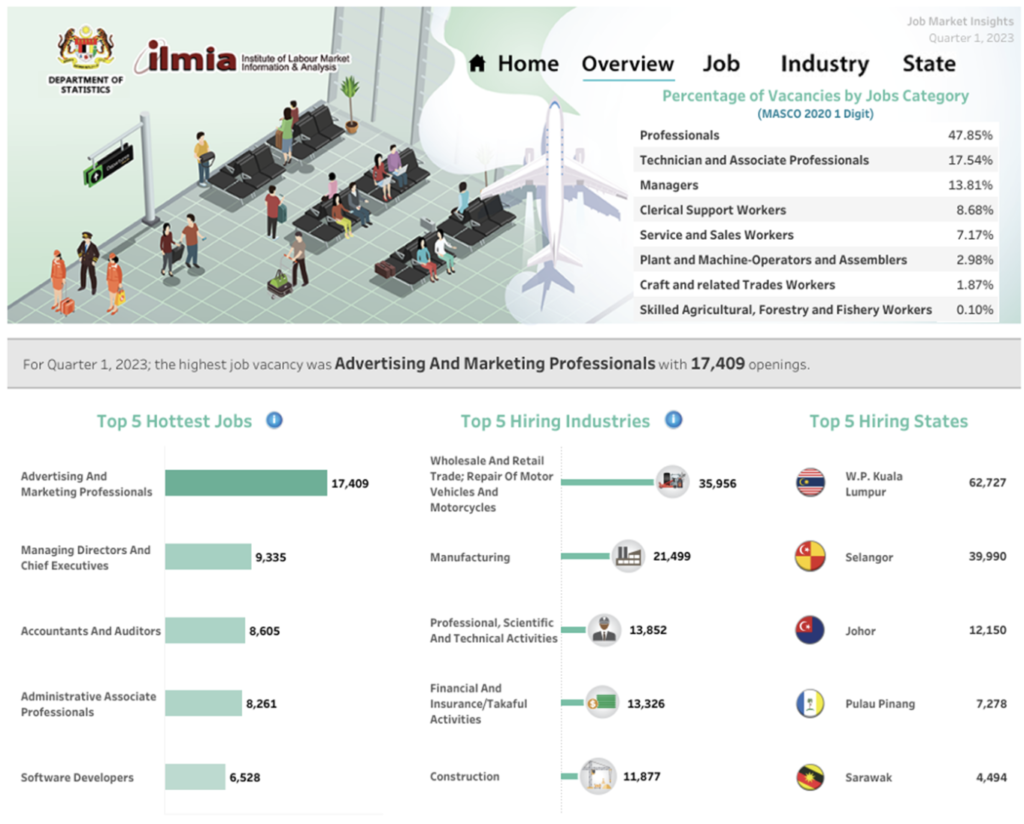
Job Market Insights, Quarters 1, 2023

National Career Development Centre Associations (NACDA Malaysia) Program
Youth Employment Dialogue
9th May 2023 – Youth Employment Dialogue Event organized by NACDA Malaysia featuring YB Liew Chin Tong, Deputy Minister from Ministry of International Trade and Industry (MITI).
The event brought together representatives from employer associations, government officials and educational institutions’ career services, to network and discuss on addressing youth employment and providing high-skilled employment opportunities for youth.
Also attended were representatives from employer associations such as:
Based on a NACDA Malaysia Student survey recently (454 responses), the report indicated that Fair Pay, Career Growth and Work Life Balance are the top 3 factors when choosing a job.
65.8% of them perceive RM3,000 & above as a fair pay to survive.
82% Interested in taking up at least 1 internship and 90% Interested to join immersive programs
However, from employers view about only 54.5% offers RM2,500 & above as minimum monthly salary; 29% offers RM3,000 & above.
Generally employers are finding it challenging to hire, this is where we all (career services, educators) play an important role of connecting the employers and students, helping to close the gap.
How do we close the gap?
Enhance Transparent Communication – Coffee chats featuring industry and student leaders.
Practical Exposure to Real World Challenges – Internship and immersive program
Career Guidance and Mentorship – Immersive program and mentors access
Youth Employment Initiative – Events and Timeline
May – Youth Employment Dialogue
June – Survey on students and employers
July – August – Educate and upskill
September – Network & Connect
In August 2022, employed persons remained stable by registering an increase of 0.2 per cent or equivalent to 39.3 thousand persons to record 16.02 million persons (July 2022: 15.98 million persons). In terms of seasonally adjusted data, the number of employed persons rose by 0.4 per cent. The employment-to-population ratio, which indicates the ability of an economy to create employment, went up by 0.1 percentage points, recording 67.1 per cent in August 2022 as compared to July 2022 (67.0%).
By economic sector, the number of employed persons in the Services sector remained on an increasing trend, particularly in Food & beverages services; Wholesale & retail trade and Administrative & support service activities. A similar trend was observed in the Manufacturing and Construction sectors, while the number of employed persons in the Agriculture and Mining & quarrying sectors continued to decrease.
Looking at the status of employment, the largest share of the total employed persons was in the employee’s category with a share of 76.0 per cent. This category increased by 0.2 per cent (+22.1 thousand persons) to 12.17 million persons during the month (July 2022: 12.14 million persons). On the same note, the own-account workers remained on an upward trend with an addition of 17.2 thousand persons (+0.6%) to record 2.80 million persons (July 2022: 2.79 million persons). This group consisted mostly of daily income earners working as small business operators such as retailers; hawkers; sellers in markets and stalls, as well as smallholders.
In August 2022, the number of unemployed persons sustained its downward trend, posting a reduction of 1.4 per cent (-8.7 thousand persons) to record 612.0 thousand persons (July 2022: 620.7 thousand persons). On the contrary, in seasonally adjusted terms, the number of unemployed persons rose by 0.5 per cent. August’s unemployment rate was unchanged at 3.7 per cent, while the seasonally adjusted estimates for the unemployment rate remained at 3.6 per cent.
During the month, the number of labour force strengthened further with an increase of 0.2 per cent (+30.5 thousand persons) to 16.63 million persons (July 2022: 16.60 million persons). Consequently, the labour force participation rate (LFPR) continued to increase by 0.1 percentage points, registering 69.7 per cent. The seasonally adjusted estimates showed that the labour force rose by 0.2 per cent, while the LFPR remained at 69.7 per cent.
The number of persons outside labour force remained on a declining trend with a reduction of 5.9 thousand persons (- 0.1%) to record 7.24 million persons (July 2022: 7.25 million persons). The largest composition of the outside labour force was mainly in the housework/ family responsibilities category, comprising 42.9 per cent, while the next was the schooling/ training category with a share of 40.4 per cent.
Malaysia’s economic performance is observed to continue improving, as reflected by the economic indicators showing positive growth, such as the external trade indicators, which recorded a significant increase in August 2022 as compared to the previous year. Similarly, the Leading Index (LI), which anticipates the economy’s direction for the next four to six months, remained stable. Thus, the outlook for the Malaysian economy is expected to remain optimistic in the future based on the smoothed long-term trend index, which continues to surpass 100.0 points. In line with the improving economic condition, the labour market is also expected to continue to flourish in the upcoming months, coupled with new entrants into the labour market as well as the entry of foreign labour into the country in the near future, which is expected to meet the increasing needs of the labour force in the market.
Job placements not as encouraging
Source: The Edge Markets
Introduction
The year 2021 had observed the unprecedented COVID-19 public health crisis prolonged in the second year after the World Health Organisation announced the virus as a global pandemic in March 2020. The continuously high number of daily cases and deaths posted challenges to countries around the world in executing strategies and initiatives towards social and economic recovery. Since Malaysia too was no exception to the challenging situation in 2021, a more targeted and strategic mechanism was exercised throughout the year to protect lives, reduce the burden of the public health system and ensure the livelihood of the nation.
Numerous initiatives were rolled out by the Government to cushion the impact of COVID-19 pandemic towards multiple groups including employers & employees, micro, small & medium enterprises (MSMEs), graduates and youths. The overarching stimulus package namely National Economic Recovery Plan (PENJANA) which encompassed an allocation of RM35 billion was an inclusive and holistic approach for supporting Malaysia’s economic recovery. Among the initiatives in PENJANA were The Hiring Incentive Programme, an economic recovery initiative to promote job creation among employers while increasing employment prospects. Additionally, PENJANA KPT-CAP Programme covered three sub-programmes namely Place and Train, Entrepreneurship and Gig Economy intended to address the challenges of graduates’ employability and unemployment.
Graduates Statistics 2021 presents the statistics of graduates within and outside the labour force as well as the salaries & wages of graduates in Malaysia. Various data sources were utilised in compiling the statistics namely the Labour Force Survey, Higher Education Statistics, Graduate Tracers Study and Salaries & Wages Survey. Graduates are defined as individuals aged 15 years and above with highest certificate obtained from universities, colleges, polytechnics, recognised bodies or equivalent, in which the duration of study is at least two years. Graduates are classified into two categories of certification namely Diploma and Degree.
Principal Statistics of Graduates
In 2021, the number of graduates in Malaysia increased by 4.7 per cent to record 5.61 million persons (2020: 5.36 million persons). The number of graduates in the labour force which encompassed of employed and unemployed rose 4.6 per cent to 4.77 million persons (2020: 4.56 million persons). Meanwhile, graduates’ labour force participation rate (GLFPR) remained as in the previous year at 85.0 per cent.
Employed graduates went up by 5.0 per cent as against 2020 to register 4.57 million persons (2020: 4.35 million persons). On the other hand, graduates’ unemployment rate eased to 4.1 per cent as compared to 4.4 per cent recorded in the preceding year. Accordingly, the number of unemployed graduates reduced by 2.5 per cent (-5.0 thousand) to 197.4 thousand persons as opposed to 202.4 thousand unemployed graduates in 2020.
In the meantime, the number of graduates outside labour force increased by 5.0 per cent to 841.3 thousand persons (2020: 800.9 thousand persons).
Employed Graduates
Looking at gender distribution of employed graduates in 2021, the share of female was higher at 51.9 per cent or 2.37 million persons while male comprises of 48.1 per cent (2.20 million persons). As compared to the previous year, the number of female employed graduates experienced higher annual growth of 7.4 per cent in 2021 as opposed to an increase of 2.5 per cent in the number of male employed graduates
By status in employment, nearly 90 per cent of employed graduates were in the category of employee with 4.03 million persons. Employed graduates in the category of own account worker which could also be associated with entrepreneurship comprised of 6.4 per cent (290.4 thousand persons), followed by employer at 4.3 per cent (196.6 thousand persons). Meanwhile, another 1.1 per cent (48.9 thousand persons) of employed graduates were unpaid family workers.
Analysis by occupation category, around two-third of employed graduates (64.8%) were in the skilled occupations category, accounting for 2.96 million persons. The highest share of 41.1 per cent (1.88 million persons) were employed in Professional occupation, followed by Technicians and associate professionals with 16.6 per cent (758.2 thousand persons). On the contrary, another 35.2 per cent of graduates worked in semi-skilled and low-skilled occupation categories. These groups could be identified as occupation mismatch considering their educations, knowledge and skills could not be fully utilised to their current work. Employed graduates in semi-skilled category which accounted for 32.9 per cent (1.50 million persons) were largely employed as Clerical support workers (14.4%), followed by Service and sales workers (10.8%) and Craft and related trades workers (4.2%). The remaining of 2.3 per cent (106.0 thousand persons) were employed in low-skilled category.
Labour Demand, Third Quarter of 2021
Total jobs in economic sector in Q3 2021 declined by 66 thousand to 8,406 thousand as compared to the same quarter of the previous year (Q3 2020 8,472 thousand). The number of filled jobs was 8,232 thousand with the rate of 97.9 per cent while the rate of job vacancies accounted for 2.1 percent with 174 thousand job vacancies. There was 15.04 thousand jobs created in this quarter.
Labour Demand by Skill
In terms of share across skills category, jobs in semi-skilled category recorded the highest share of 62.3 per cent (5,238 thousand). Skilled category ranked second at 24.7 per cent with 2,075 thousand jobs. A total of 13.0 per cent of jobs (1,093 thousand) were in the low-skilled category.
Skilled category recorded 2,075 thousand jobs, rose by 6 thousand from the same quarter of the previous year (Q3 2020: 2,069 thousand) comprising of 98.0 per cent rate of filled jobs (2,033 thousand) and job vacancies of 2.0 per cent (42.1 thousand). Meanwhile, 4.5 thousand jobs were created in this category.
The number of jobs in semi-skilled category decreased by 40 thousand posted 5,238 thousand jobs in this quarter as compared to the same quarter of the preceding year (Q3 2020: 5,278 thousand). Out of this total, 98.2 per cent was filled jobs (5,142 thousand) while 1.8 per cent was job vacancies (95.4 thousand). This category recorded 9.3 thousand of jobs created.
The year-on-year performance of low-skilled category reduced by 2.9 per cent to 1,093 thousand jobs with (Q3 2020: 1,125 thousand). Filled jobs accounted of 96.7 per cent of total jobs (1,056 thousand) while job vacancies rate was 3.3 per cent (36.6 thousand). A total of 1.2 thousand jobs were created in the low-skilled category.
Labour Demand by Economic Activity
Looking at the breakdown by economic activity, more than half of jobs and filled jobs with a share of 51.7 per cent (4,342 thousand) and 52.4 per cent (4,317 thousand) respectively were in Services sector. Within the same period, Manufacturing sector recorded 2,286 thousand jobs (27.2%) and 2,187 thousand of filled jobs (26.6%).
The highest vacancies recorded by Manufacturing sector with a share of 56.9 per cent (99 thousand) followed by Agriculture (16.5%; 29 thousand) and Services (14.6%; 25 thousand).
The percentage share of jobs created primarily dominated by Manufacturing sector with 43.9 per cent (7 thousand). Services sector ranked second with 34.9 per cent (5 thousand) and followed by Construction (15.8%; 2 thousand).
|
No |
Event |
Objectives |
Participants |
|
1. |
National Career Development Centre Association (NACDA Malaysia) Cuppa Diem: Growth and Well Being Date: 18 Nov 2021 Time: 3.00 – 4.30pm Mode: Online |
NACDA Industry Advisors as we chat and share about the growth and well-being of our career practitioners. |
Career practitioners from various HEIs Career Centers |
|
2. |
Government Linked Universities (GLU) Student Leadership Summit 2021 – Future of Graduates Session Date: 13 Nov 2021 Time: 12.00 – 1.00 pm Mode : online |
To share issues, challenges & preparations required for students, fresh graduates relevant with remote working, agile environment with Covid 19 pandemic |
120 student leaders from Universiti Teknologi Petronas (UTP), Universiti Tenaga Nasional (UNITEN), Universiti Kuala Lumpur (UniKL) and Multimedia University (MMU) |
|
2. |
NACDA Malaysia Dialogue Series Dialogue Series (A Mini Forum) with Widya Mandala Surabaya Catholic University (WMSCU), Indonesia. Date: 1 Nov 2021 Time: 11.00 am -12.30 pm Mode: online |
To share issues and challenges for business graduates’ students for employability in Malaysia & Indonesia |
Career practitioners, lectures from Business School from various universities, colleges. |
|
3. |
NACDA Malaysia Q3 Members Meeting Date: 30 Sept 2021 Time: 10.00 am – 12.00 pm Mode: online |
To share latest updates about student career development, graduates’ employability & labor information market trends, insights |
Career practitioners from various HEIs Career Centers |
|
4. |
EduHub Chat Series 3# Date: 7 October 2021 Time: 3.00 -4.00 pm Mode: online Speaker: Ms Emily Rose Lizada, Career Counsellor, Ateneo de Manila University (ADMU) |
To share HEI students career development and graduate employability initiatives, programs, and partnerships with industries in Philippines |
Career practitioners from various HEIs Career Centers |
|
5. |
#SpendLikeLokal: Merdeka Youth Forum
Session 2: Employable Tomorrow: Are You a Survivor? Day 2 Date: 29 August 2021 (Sunday) Time: 2.00 -4.00 pm Online
Speakers 1. Baktiar Hasnan, President National Career Development Centre Association Malaysia 2. Khairul Ikwan, Founder & Manager of Gig, Venture Enterprise |
an initiative by International Welfare, Economics & Leadership Dialogue (I-WELD), in collaboration with Youth Ventures Asia, presents the inaugural Merdeka Youth Forum; a 3 days virtual roundtable with one big aim, empowering youth to take active participation in shaping the future of Malaysia.
|
Youths |
MINISTRY OF HIGHER EDUCATION INITIATIVES TO BOOST GRADUATE EMPLOYABILITY.
Top of Form
One of the current priorities for the Ministry of Higher Education (MOHE) is to improve the education system, while producing more holistic and employable graduates
Higher Education Minister Datuk Seri Dr Noraini Ahmad have outlined a five-year plan with four main strategies aimed at producing better graduates that are ready for the workforce.
These strategies revolve around reinforcing talent, expanding careers of graduates, enhancing teaching, and learning, and strengthening industry ties.
For example, the ministry has partnered with Social Security Organisation (SOCSO) to provide graduates access to national employment portal MYFutureJobs. Besides that, TalentCorp is offering its Nurturing Expert Talent module to help with career profiling.
These are timely initiatives, as a study by MOHE showed that the graduate employability rate decreased by 1.8% in 2020
The 2020 Graduate Tracking Study found that Malaysian graduates had a marketability rate of 84.4%, compared to 86.2% in the previous year. In other words, up to 40,550 graduates were not able to secure a job within six months of graduating.
To help make it easier for graduates to find out about job offers and other opportunities, the government introduced Graduates Reference Hub for Employment and Training (GREaT) in September 2020. The one-stop portal now even includes a feature to automatically match unemployed graduates with suitable job vacancies found in their database.
Nevertheless, a positive sign is that polytechnic graduates are in high demand, with a marketability rate of over 90% for five years in a row
Despite the pandemic, polytechnic graduates still had a 91.2% marketability rate in 2020.
That is why the Ministry of Higher Education will continue to look at the betterment of the Technical and Vocational Education and Training (TVET) programme, along with programme accreditation and recognition at the international level.
Following the tabling of #Bajet2022, Budget 2022, the government announced that MOHE has been allocated RM14.5 billion, which will help education agencies as well as students. Here’s how
1. Of the RM14.5 billion allocation, RM11.5 billion will be used for operating expenses and RM3 billion will be channelled for development expenses.
2. From 1 November 2021 to 30 April 2022, those who are repaying their National Higher Education Fund Corporation (PTPTN) loans in full will get a 15% discount. Those who are repaying at least half of their loan balance will get a 12% discount. Also, if you repay your PTPTN loans through salary cuts or scheduled direct debit, you’ll be given a 10% discount.
3. Companies that offer scholarships to students will receive double tax deduction, and this policy is now applicable to all fields of study.
4. An estimated 600,000 students from B40 families will receive free tablets, with an allocation of RM450 million for this programme.
5. RM6.6 billion has been allocated for education loan programmes through Majlis Amanah Rakyat (MARA), Universiti Teknologi MARA (UiTM), and Yayasan Peneraju. The allocation will also be channelled towards helping students upgrade from certificate programmes to diplomas.
6. Over two million youths will benefit from RM150 e-wallet credit, under the government’s eStart programme to foster a culture of cashless transactions. A total of RM300 million has been allocated for this initiative.
7. Employers who hire school leavers and graduates aged 18 to 30 years old will be provided a monthly incentive of RM900. This amount will be given monthly for each hire for a period of six months.
8. The government also called for the private sector to offer an allowance of RM900 to students undergoing industrial training.
9. Tax incentives for the Structured Industrial Training Programme will be extended until the year of assessment 2025, applicable for students at different levels, including master’s degree, Professional Certificate, and Malaysian Skills Certificate Level 1 and 2.
10. RM423 million has been allocated for the Ministry of Science, Technology, and Innovation (MOST) and MOHE to enhance R&D activities. This includes RM295 million for public universities to play a role in research and innovation.
11. In an effort to increase access to screening and health education, mobile clinic services will be expanded to university teaching hospitals. The capacity of public health service facilities will also be increased, with RM4 billion allocated for the implementation of vaccination programmes as well as other efforts to address COVID-19, including university teaching hospitals.
12. RM6.6 billion will be allocated to the TVET industry, with an additional RM200 million for joint venture programmes with the industry.
13. The government will be carrying out projects like road maintenance, infrastructure renovation, and updating equipment at public universities, polytechnics, and community colleges, with a total allocation of RM2.9 billion.
14. Pioneered by Universiti Sains Malaysia (USM) in Penang, the government will be implementing community-based rehabilitation programmes at more universities starting next year.
In addition to these initiatives, daycare facilities will be offered at public universities to support working mothers. The Malaysian Research and Education Network (MYREN) will also get a RM50 million network upgrade, from 500Mbps to 10Gbps.
February 2021 Malaysia report
COVID-19’s impact on Malaysia:
Third Wave of COVID-19 – Total cases in Malaysia have gone up to 223K, 791 deaths.
MCO (Movement Control Order)
The government has reinstated the Movement Control Order (MCO) in the states of Penang, Selangor, Melaka, Johor and Sabah as well as the federal territories of Kuala Lumpur, Putrajaya and Labuan for a two-week period starting Jan 13, 2021. MCO is extended until Feb 18, 2021 and involved all states in Malaysia besides Sarawak
Educational institutions (from primary school to secondary school -Start the academic year on Jan 20, 2021 with online classes.
COVID-19’s impact on Malaysia:
International Seminar Counselling and Well-Being (ISCWB 2020).
Reopening of schools and universities
Reopening of schools starting July 15. Co-curricular and sports activities cannot be held yet, students and teachers only come to school for teaching and learning.
Malaysia Cabinet had agreed for all university students to eventually return to campuses by October 2020.
International Counseling Convention (ICC2020), Malaysia
International Counseling Convention (ICC 2020), Malaysia is postponed to another date due to COVID-19 happening worldwide.
STEM FOR SHARED PROSPERITY FORUM
University of Malaya (Malaysia) will be organising STEM For Shared Prosperity Forum on 29th November 2019 (Friday) at Physics Department, University of Malaya (2.45-4.30pm).