

APCDA members have spoken, and we are delighted to introduce Mrs. Effrosyni (Sini) Parampota as APCDA’s President-Elect.
Over the next three years, Sini will serve in APCDA’s leadership succession as President-Elect (2026–27), President (2027–28), and Past President (2028–29), helping guide the association through its next chapter. We are excited about the experience, dedication, and thoughtful leadership Sini will bring to this important role as APCDA continues to strengthen the career development profession across the Asia-Pacific region.
This election reflects the strength of APCDA as a member-led association. We are deeply grateful to every candidate who stepped forward to serve. Standing for election is a significant commitment, and every nominee demonstrated a willingness to contribute their time, expertise, and vision for the future of our profession. While there can only be one successful candidate, every person who accepted the nomination has helped strengthen our association.
 By Arun Mittal
APCDA has initiated an accreditation process for training programs designed for career development practitioners and offer a credential upon completion of the training program. We call these programs Career Development Credentialing Programs, so we call our process CDCP Accreditation. CDCP Accreditation has been designed to strengthen and recognize quality career development training across the Asia-Pacific region.
As career development continues to emerge as a critical profession in supporting individuals through education, employment, and lifelong career transitions, there is a growing need for training programs that meet recognized standards of quality and professional practice. APCDA’s CDCP Accreditation has been developed to address this need by providing an independent review and endorsement of career development training programs.
The purpose of accreditation is not to replace or compete with existing training programs. Rather, APCDA Accreditation serves as an added layer of professional recognition, enhancing the value and credibility of both established and newly developed programs. Training providers can continue to deliver their unique curriculum, methodologies, and learning experiences while benefiting from APCDA’s endorsement that their programs align with recognized career development competencies and professional standards.
Under this initiative, universities, professional associations, private training providers, government agencies, and educational institutions offering career development education may apply to have their programs reviewed. Accredited programs will demonstrate that they adequately prepare learners with the knowledge, skills, ethical understanding, and professional competencies expected of career development practitioners.
 By Grace Koamesah
The 2026 APCDA Hybrid Conference in Kuala Lumpur, Malaysia, has been another unforgettable experience. Beyond the applause, a conference’s success is reflected not only in its sessions but also in the insights of its attendees. Following the event, attendees were invited to share their overall feedback through a post-conference survey in Whova. This summary presents the highlights of the survey results from 41 respondents who shared their insights on what they value most from the conference, as well as valuable improvements for future conferences.
Valuable aspects of the conference
Respondents were asked to rank the aspects of the conference that influenced their decision to attend (6 = Most important, 1 = Least important), with Presentation quality ranked as the most important aspect (4.20). This finding is supported by the open-ended responses where 46% of respondents commented that they gained valuable insights from presenters of diverse backgrounds and from the wide range of topics. The second highest-ranked aspect is Networking (3.82), and 60% of respondents appreciating the opportunity to connect with fellow career advocates and industry professionals across the Asia-Pacific region. The third most important factor was Overall cost (3.45). Many respondents highlighted APCDA’s sense of purpose and strong sense of belonging and camaraderie, noting that interactions with career practitioners from different countries reinforced the value of APCDA membership.

By Dr. Elisabeth Montgomery
Conference Snapshot
From April 20–29, 2026, APCDA and our gracious hosts at Universiti Malaya, Kuala Lumpur perfected the hybrid format for the theme most expertly embraced: “Inclusive Career Development in Global Transitions.” According to the numbers, among our 453 total participants, 178 attended the conference in person, while 275 were virtual. The largest groups of attendees were from our neighbors in Singapore, then Malaysia, Vietnam, India, United States, Japan, the Philippines, Australia, Indonesia.
Inclusivity as Purpose
The Universiti Malaya is the oldest and most respected university in Malaysia, making it an ideal setting for our hybrid conference by facilitating meaningful discussions, cultural exchanges, and global collaborations that advance inclusive career development. Our Asia Pacific theme rekindled the flames, making it the central purpose of the presentations, sharpening new employment skills and strategies in the field.
What emerged was an exceptional amount of regional creativity and advocacy from all sectors of the region and beyond. And a few fiery manifestos! Many advocated for workforce change, embracing entrepreneurship, working with AI/automation, implementing workplace mitigations to secure long-term onboarding, and defining success in new ways. Members re-energized around disabled participants and young women, especially within our youth contingencies. Amid extreme regional climate transitions, research on expanding career education focused on securing and protecting inclusive access.
The Keynote & Panel Themes
Universiti Malaya, APCDA’s gracious host, invests in inclusive leadership development, professional learning, and emerging voices, partnering with government, corporations, and nonprofits to design principled opportunities for inclusive workplaces.
The conference opened with an opening Keynote from UM EXPERT Dr. Ahmad Shamsuri Muhamad, Senior Lecturer in the Department of Educational Psychology and Counselling, Faculty of Education, Universiti Malaya, who addressed “From Barriers to Breakthroughs: Building Resilient and Inclusive Practices in Career Development” bridging diversity in career development. He was followed by the Dean of the Faculty of Education, and UMEXPERT, Department of Educational Management, Planning and Policy Prof. Dr. Ahmad Zavidi bin Abdul Razak on the theme of Holistic Human Development.
Keynote speaker Dr. William E. Donald, an Associate Professor of Sustainable Careers and Human Resource Management led the topic, “Shaping a Sustainable and Inclusive Career Ecosystem: A Collective Call to Action” calling for a career ecosystem both technologically advanced and human centric. He was followed by distinguished Keynote speaker Dr. Roberta Borgen, President of Life Strategies Ltd., Canada. Her conviction was “It takes a Village: Bridging the Diversity Disconnect in Career Development.” Inclusive workforce development, resilience, disability inclusion, holistic human development, career development in transitions, and the future of work were covered across the Asia Pacific!
Conference Panel Discussion.
Elisabeth Montgomery, PhD, moderated the conference’s signature panel discussion that brought together five leaders from across Malaysia’s employment ecosystem to ask how social enterprise, government, the HR profession, employers, and academia can collaborate to solve talent scarcity while keeping people at the center. The Panel Discussion, “Bridging the Divide: Shaping an Inclusive and Resilient Workforce in Malaysia’s Global Transition” began with panelists naming mega-trends in their fields. They then discussed cross-sector collaboration and closed with a collective call to action – aligning with Dr. William Donald’s keynote calling for a career ecosystem both technologically advanced and human-centric.
Ms. Grace Gan Wei Ching (Enabling Academy, Yayasan Gamuda) drew on her fifteen years as a coach to show what inclusive hiring looks like in practice for neurodivergent talent and how coaching capability is built and scaled. And Ms. Gayathri A/P Vadivel), a pioneer of Malaysia’s Return to Work programme (sponsored by PERKESO) and director of the MYFutureJobs portal, examined large-scale employment support and how digital platforms can widen inclusion rather than create barriers.
Mr. Simon Benjamin (Malaysian Institute of Human Resource Management) brought three decades in employee relations to embedding inclusion into core HR systems rather than side programs. While Ms. Siti Norliza Mohd Sahar (Liza Sahar) (CIMB) spoke on widening the talent funnel, shoring up populations with scarce digital skills, and inclusive recruitment mechanics, while framing retention as the other half of talent acquisition. And Dr. Pang Jee Ching (Universiti Malaya) offered person-centered, rights-based principles for supported employment, making the case for inclusion as a source of workforce resilience.
Together, the panel modeled the conference’s conviction that inclusive, human-centric employment is the foundation of a resilient workforce — and that Malaysia’s model offers a blueprint for others.
by Elisabeth Montgomery, PhD
The APCDA 2026 Conference welcomed scholars from across the Asia Pacific and beyond as one shared professional community. Through conference sessions, informal exchanges, and guided conversations, scholars connected across regions, disciplines, and telling their lived experiences. Those attending the Conference in person brought their voices and inquiries forward, engaging leaders in fresh perspectives on career development, inclusion, resilience, and the future of work.
Within this wider scholar community, APCDA also welcomed Resilience Scholars whose professional commitment continues under conditions of conflict and disruption. Their presence deepened the meaning of inclusion—not as a separate category, but as a shared responsibility to create access, dignity, and belonging for all scholars.
By Dr. Elisabeth Montgomery
In Kuala Lumpur on May 1, the full APCDA board, officers, and staff gathered to create a shared purpose, inspiring a sense of unity and collective pride in shaping our future. What emerged was more than a strategic plan. It was an articulation of APCDA’s DNA, our values, commitments, and aspirations that bind this Asia Pacific community together. We also articulated a calling: to connect, reflect, inform, and grow a global community of practice in career development.
There was something different about those of us in the room by the time the closing remarks began. Participants described it as a palpable shift in atmosphere that led to a deepened sense of trust and common purpose, transforming a routine governance gathering into something more like a founding moment by the end of a six-hour day at the Urban Living Residence in Kuala Lumpur. The APCDA 2026 Leadership Retreat set the course for everything the association intends to become.
The retreat brought together the full board, officers, and staff, with several participants connecting virtually and across time zones to address three interlocking questions: What do we truly stand for? How do we build structures that last? And who will carry APCDA’s mission forward into a rapidly changing career development ecosystem?
The image below is the answer the room produced together. It is the Collective Portrait of APCDA’s shared identity and the hub to which everything else in this article connects.
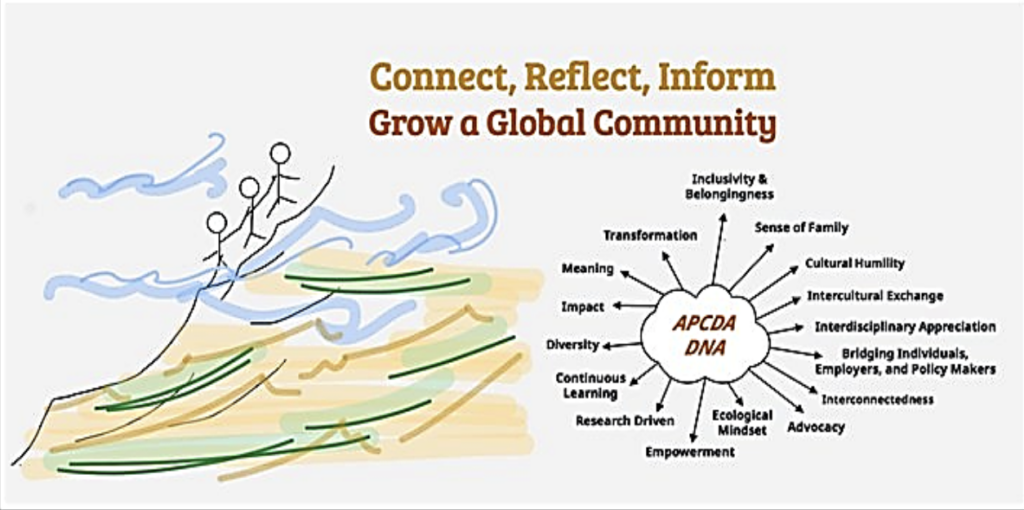
The APCDA Collective Portrait. At its heart, APCDA’s DNA and the values that define who we are is the path we walk together.
What APCDA’s DNA contains
The values radiating from the center of the Collective Portrait were named, refined, and arranged by the participants themselves as the retreat unfolded. From the emerging individual reflections, tested in collective conversation, we finally drew the vision together into a single picture. Three main categories of commitment come into focus:
How we belong to each other: Inclusivity & Belongingness, Sense of Family, Cultural Humility, Intercultural Exchange, Interconnectedness, and Diversity.
How we work in the world: Bridging Individuals, Employers, and Policy Makers; Advocacy; Interdisciplinary Appreciation; Research Driven; Ecological Mindset; Empowerment.
How we grow: Continuous Learning, Meaning, Impact, and Transformation.
The top of the Portrait features four words serving both as a vision and an invitation:
Connect. Reflect. Inform. Grow – A Global Community. In other words, expand our Global Community. These words are an open call to all members, emphasizing that our collective growth depends on active community engagement and shared effort.
Why a retreat and the emerging vision?
Years of growth in membership, conferences, and regional reach revealed structural gaps that routine board meetings could not address. We needed quality time together to develop clearer roles for leaders and staff, conference protocols stretched by complexity, a revenue model facing the limits of scalability, and the unanswered question of who would carry APCDA forward.
Sini Parampota and Allan Gatenby selected Role Biography (Long, 2026) as their leadership development method. We had practiced this last year with significant success. This socio-analytic approach encourages participants to examine their professional journeys by considering both the roles they have undertaken and those they aspire to pursue. This methodology surfaces the patterns, values, and motivations that conventional strategic planning rarely reaches. Members create safe space conditions for alignment and trust, making the visions of the DNA Portrait viable.
The people who made it happen. Lead facilitators Allan Gatenby (Past President) and Sini Parampota (Secretary) joined remotely. In the room: Elisabeth Montgomery (President & Co-Facilitator), Lau Poh Li (President-Elect & Host), Nila Vitug-Urrea (Treasurer), Roberta Borgen (Board/Committee), Natalie Kaufmann (Board/Committee), Brian Schwartz (Officer/Area Council), Baktiar Hasnan (Chair, Area Council). Staff team: Arun Mittal (Executive Director), Marilyn Maze (Finance), Emily Lizada, Tuan Anh Le, and Grace Koamesah (Association Assistants). Gaini Yessembekova (PR Committee) could not attend.
Three main themes ran through every stage: Leadership development, mapping directly onto the DNA values of Continuous Learning, Empowerment, Transformation, and Impact.
 By Natalie Kauffman
APCDA’s nine (9) currently active committee volunteer staff along with journal volunteer staff total almost 130 association members and span the following 25 countries and 2 SARs: Australia, Cambodia, Canada, China, Egypt, Hong Kong, India, Indonesia, Japan, Kazakhstan, Kenya, KSA, Lebanon, Macau, Malaysia, Mongolia, New Zealand, Pakistan, Philippines, Samoa, Singapore, S. Korea, Taiwan, United States, Vietnam, and Yemen
Awards & Scholarships Committee Awards Co-Chair (& former APCDA President), Prof. Dr. Narender K Chadha, shared the deadline for our 2025 APCDA Awards is fast approaching, Sunday, March 15th. The three (3) possible awards include: Outstanding Career Practitioner Award, Outstanding Educator of Career Professionals Award, and Lifetime Achievement Award. For further details on our association’s 2026 Awards Nomination Process, pease see: https://asiapacificcda.org/awards/
Scholarship Committee Co-Chairs Tuan Anh Le and Dr. Ma. Leonila V. Urrea (& current APCDA Treasurer) determined the selection criteria by which over 140 scholarship applications were evaluated and 123 scholarships were awarded. The Resilience Scholarship team have been virtually meeting with conflict-zone scholarship applicants. The committee will provide a Scholar Meetup in April to prepare scholars to take advantage of the conference and a video of the selected scholarship recipients which will be shown during the Awards Ceremony at our upcoming Malaysia conference.
Bylaws Committee Co-Chairs Allan Gatenby (also immediate past APCDA President, Accreditation Committee Chair, & Nominations & Elections Committee Chair) and Natalie Kauffman (also Committee Council Chair & Membership Committee Co-Chair) and the Bylaws team have met to discuss possibly adding five (5) additional components to APCDA’s Policy and Procedures (P&P) Manual. They cordially invite all interested association members to join them on Sunday evening, March 22/Monday morning, March 23 to begin to update APCDA’s P&P Manual. Whether you have previous nonprofit bylaws writing/editing experience or are interested in building your experience, your participation is warmly welcomed. If interested in attending, please email the Co-Chairs at Bylaws@AsiaPacificCDA.org.
Ethics and Standards Committee Chair, Dr. Vandana Gambhir Chopra and the committee team are gearing up for their Malaysia Conference presentation; an interactive session inviting career development professionals to collaboratively reflect on existing standards and ethical practices in the field. Participants will have the opportunity to share perspectives, identify emerging ethical challenges, and help strengthen a shared, values-driven professional framework.
News Committee Chair, Momoko Asaka, (& former APCDA President) invites submissions to APCDA’s Weekly News. Please link to the following and scroll down for the HOW To guidelines:
https://asiapacificcda.org/news/
Natalie Kauffman and Kunimitsu Kuki, Membership Committee Co-Chairs, and the Membership Committee have been enjoying meeting with NEW and potential APCDA members through individual and
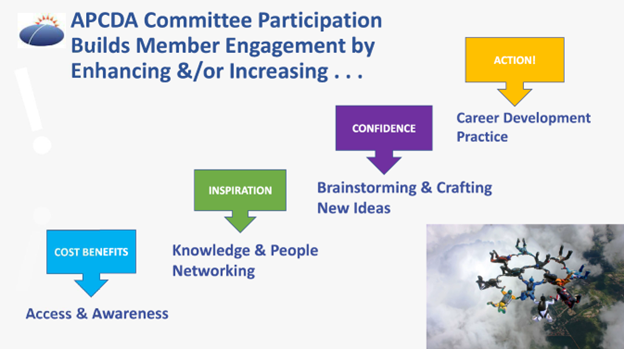
At APCDA, much of the work is done by our Standing Committees (groups that continue year after year). All members are welcome to join.
Joining a committee is a great way to get to know other members personally and build global relationships, in addition to providing a really valuable contribution to the field of career development. Below are comments from the chairs of our standing committees about the unique benefits each committee offers.
Natalie Kauffman, Membership Committee Co-Chair
 “APCDA offers a lot of services, more than most members know about. Members of the Membership Committee help others learn how to use these services and connects you to the new members and potential new members. You can build worldwide connections and help others to take full advantage of what APCDA has to offer.”
Kunimitsu Kuki, Membership Committee Co-Chair, Membership@AsiaPacificCDA.org
 “Joining the Program Committee offers a unique opportunity to shape impactful professional development for APCDA members by identifying relevant topics, connecting with expert speakers, and facilitating engaging webinars. As a committee member, you’ll contribute to the continuous professional development of career professionals across the Asia-Pacific region, while also expanding your network and enhancing your professional skills.”
Syed Hassan Abdullah, Program Committee Co-Chair, Program@AsiaPacificCDA.org
 “We invite you to join the Research Committee, where your experience can play a pivotal role in advancing the field of Career Development and driving impactful change. Collaborate with dedicated professionals to shape innovative research initiatives that enhance career pathways and empower individuals to achieve their goals. Together, we can inspire new ideas and foster a culture of research and innovation!”
Dr. Poh Li Lau, Research Committee Co-Chair, Research@AsiaPacificCDA.org
“We invite you to join the Research Committee, where your experience can play a pivotal role in advancing the field of Career Development and driving impactful change. Collaborate with dedicated professionals to shape innovative research initiatives that enhance career pathways and empower individuals to achieve their goals. Together, we can inspire new ideas and foster a culture of research and innovation!”
Dr. Poh Li Lau, Research Committee Co-Chair, Research@AsiaPacificCDA.org
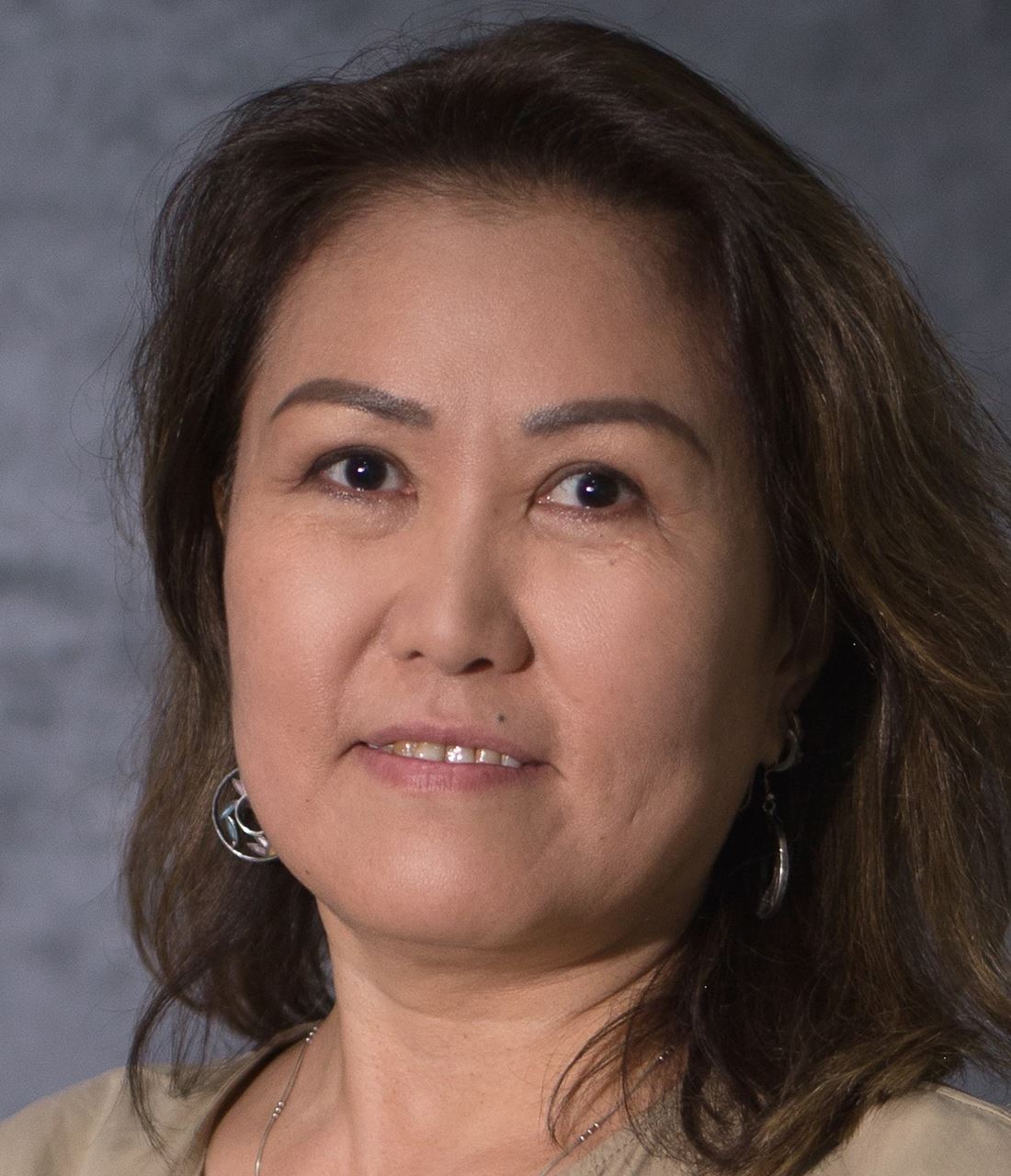 “PR Committee plays a key role in developing strategies to enhance APCDA’s visibility both in our region and globally. Additionally, you will have the chance to enhance your skills in virtual presentations, team-building, and project management—skills that are highly transferable and beneficial across various professional contexts. Most importantly, you will be making a meaningful contribution to raising APCDA’s profile.”
Gaini Yessembekova, Public Relations Co-Chair, PublicRelations@AsiaPacificCDA.org
“PR Committee plays a key role in developing strategies to enhance APCDA’s visibility both in our region and globally. Additionally, you will have the chance to enhance your skills in virtual presentations, team-building, and project management—skills that are highly transferable and beneficial across various professional contexts. Most importantly, you will be making a meaningful contribution to raising APCDA’s profile.”
Gaini Yessembekova, Public Relations Co-Chair, PublicRelations@AsiaPacificCDA.org
 “Our Ethics and Standards Committee is where your voice can truly shape the future! Imagine contributing to the very principles that guide our profession globally—standards that empower trust, integrity, and professional growth. Join us, and let’s set the gold standard together while building a network of passionate professionals dedicated to making an impact.”
Vandana Gambhir, Ethics and Standards Committee Chair, Ethics@AsiaPacificCDA.org
“Our Ethics and Standards Committee is where your voice can truly shape the future! Imagine contributing to the very principles that guide our profession globally—standards that empower trust, integrity, and professional growth. Join us, and let’s set the gold standard together while building a network of passionate professionals dedicated to making an impact.”
Vandana Gambhir, Ethics and Standards Committee Chair, Ethics@AsiaPacificCDA.org 
APCDA is an association of people who love their work and are eager to share their expertise with others. It is our goal to make that sharing as easy as possible.
In November 2023, we moved to a new website and new member database software which offers a “Member Portal” to facilitate communication among members and displays our other member services. Your Member Portal is a vital part of the services offered by APCDA. The new software offers several valuable features that were previously scattered over 2 software systems.
Unfortunately, networking with each other became more difficult when we switched because we were not able to copy the photo and bio of our members to the new system. Have you updated your Member Profile in the Member Portal? If not, we urge to do this now. Another vital piece of information is the Country where you live. Unfortunately, our new software hides that information under Address. Since we do not communicate by mail, “Address” does not seem very important. But your Country is important (and your city). December is a month for giving. We hope all of our members will make it easier for other members in need of your advice and assistance to find you by adding a photo of your face, a bio describing your areas of focus, and your country. Please help us to make member networking easier.
 Did you know that you automatically become a member of the International Association of Educational and Vocation Guidance (IAEVG) when you join APCDA? Each year, APCDA pays dues to IAEVG for all of our members.
IAEVG has a 75-year history of providing global leadership in and advocating for guidance by promoting ethical, socially just, and best practices throughout the world so that career, educational and vocational guidance and counselling is available to all citizens from competent and qualified practitioners.
Behind the scenes, IAEVG and many of its members have helped in the development of APCDA. When we want to develop resources for our members, such as our Ethical Guidelines, we turn first to IAEVG for guidance. As the oldest career development association that is truly international, the materials provided by IAEVG are very relevant and helpful in jump-starting our development.
Members are invited to download a copy of the Member Logo from the APCDA Website. The legal agreement published on our website makes it possible for our members to use this logo on your website, signature, or letterhead. We currently have five kinds of member logos:
- Individual Members
- Organization Members
- Lifetime Members
- Legacy Partner Lifetime
- Professional associations which offer Joint Membership with APCDA (Affiliates)
If you fall into groups 1 to 4, please go to our website at AsiaPacificCDA.org and click “Member Portal.” Choose Workspaces, and your member logos (as JPG or PNG files) should be waiting there for you to download. If you fall into the fifth group, you should have received the logo from us by email.